English



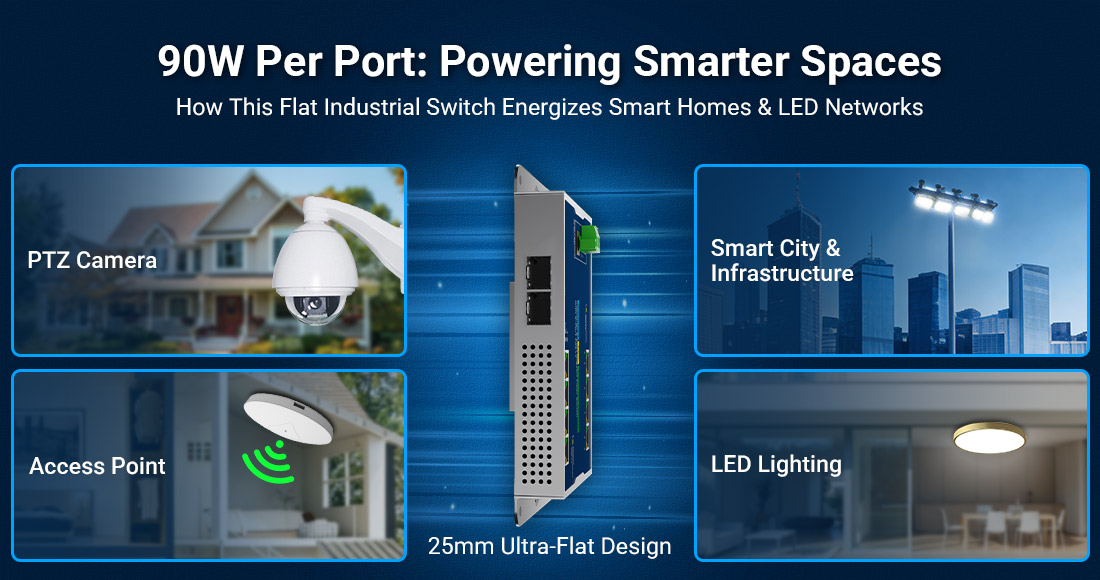
As networks grow smarter and more power-dependent, the demand for robust, high-power Ethernet infrastructure has moved beyond traditional enterprise settings into intelligent homes and advanced lighting systems. The integration of high-wattage PoE++ technology in industrial-grade switches is now enabling a seamless fusion of data and power delivery over single cables—simplifying installations while enhancing reliability. In particular, the rise of power-hungry devices such as Wi-Fi 6/6E access points, 4K/8K IP cameras, and high-density LED arrays requires a switch that can deliver substantial wattage without compromising on form factor or environmental resilience. This is where the latest generation of industrial Ethernet switches steps in, engineered to support next-generation connected environments with both high power and compact design.
At the heart of this capability is the support for IEEE 802.3bt PoE++, which delivers up to 90W per port—a significant leap from earlier PoE standards. Such high-power per port allows a single flat switch design like the IES7211W-8GE2GF-4BT to energize advanced PTZ cameras, heated outdoor surveillance units, and even multi-zone smart lighting systems without requiring separate electrical wiring. For LED networks, this means centralized control and power for bright, scalable displays and architectural lighting, all managed through a unified network backbone. The elimination of AC adapters and local power sources reduces installation complexity, minimizes points of failure, and supports greener, more energy-efficient deployments.
The hybrid port layout of this switch—featuring four high-power PoE++ ports alongside four standard Gigabit RJ45 ports—enables intelligent power management tailored for mixed-device environments. In a smart home scenario, high-wattage ports can dedicate power to wireless access points and security cameras, while non-PoE ports connect to media servers, control panels, or network storage. This separation avoids power contention and ensures consistent performance for both data-intensive and power-dependent applications. Additionally, the inclusion of dual 1.25G Gigabit SFP uplinks extends network reach with fiber connectivity, ideal for linking distributed LED displays or remote camera clusters over long distances without EMI interference.
What truly distinguishes this platform is its ultra-slim 25mm depth, allowing installation in space-constrained enclosures such as residential media panels, lighting control cabinets, or outdoor electrical boxes. The industrial durability of the switch, with its extended operating temperature range (-40°C to +75°C) and IP40 metal housing, ensures reliable performance in varying climates—whether installed in an attic, garage, or external smart pole. This ruggedness, combined with dual DC input for power redundancy, makes it equally suitable for demanding outdoor LED billboards and indoor smart lighting grids that require 24/7 operation.
From a system design perspective, deploying a compact yet high-power PoE++ switch translates into lower total cost of ownership, reduced cabling, and greater network scalability. For integrators of smart home and commercial lighting projects, this means a future-ready infrastructure that can support evolving technologies—from higher-resolution cameras to next-gen IoT sensors—without overhauling the power and network framework. In essence, switches like the IES7211W-8GE2GF-4BT are not merely connectivity devices; they become the power and data backbone that energizes intelligent spaces, merging operational efficiency with installation flexibility in an increasingly connected world.
 E-Mail Us
 Call Us
 Address
5F, Block5, GuangmingGu Industrial Park, Matian Villiage, Guangming Disitrict, Shenzhen, China



 IPv6 network supported