1 Enable Long-Reach Mode (DIP Switch Extend Mode)
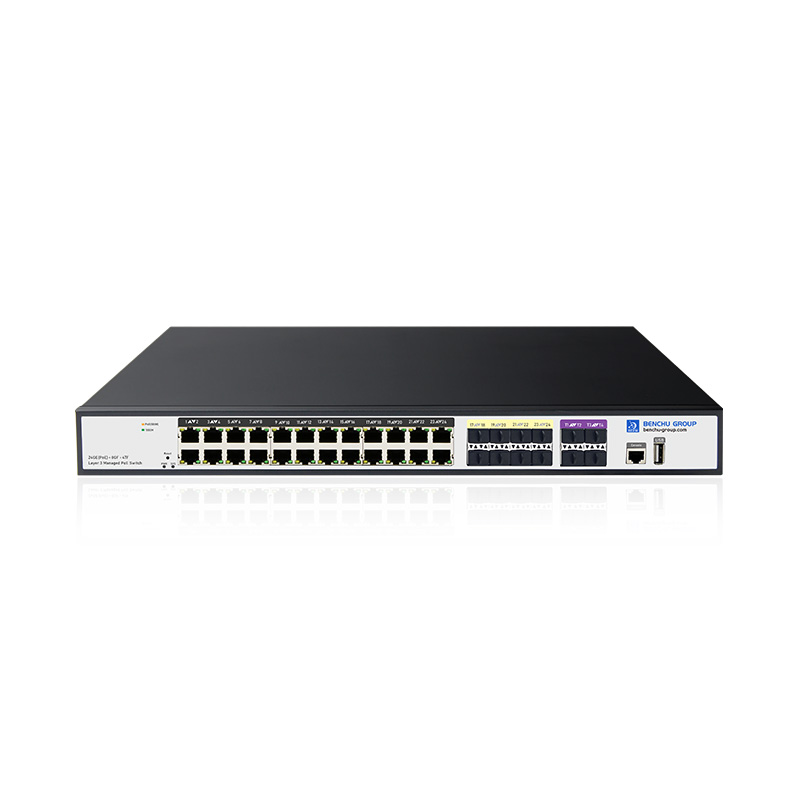
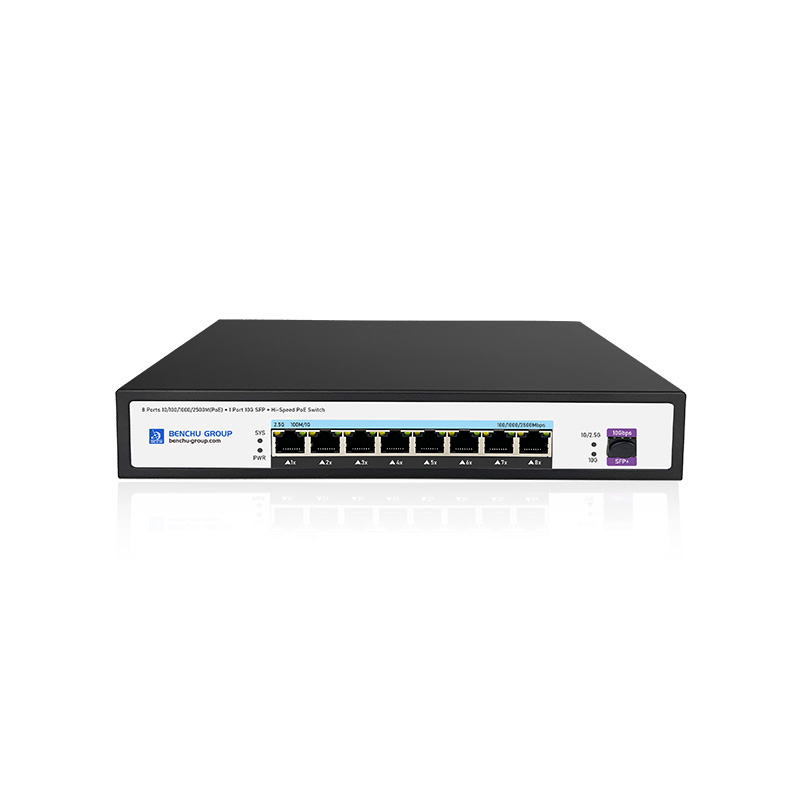
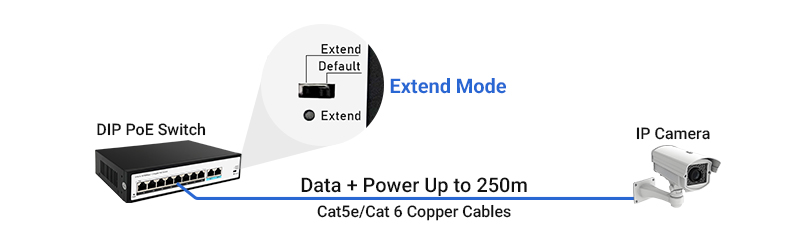
Explanation & Solution: Many network switches feature a hardware DIP switch for extended deployment. Toggling this "Extend Mode" reduces port bandwidth from 100Mbps to 10Mbps while extending signal transmission and PoE power delivery up to 250 meters over standard Cat5e/Cat6 copper cables.
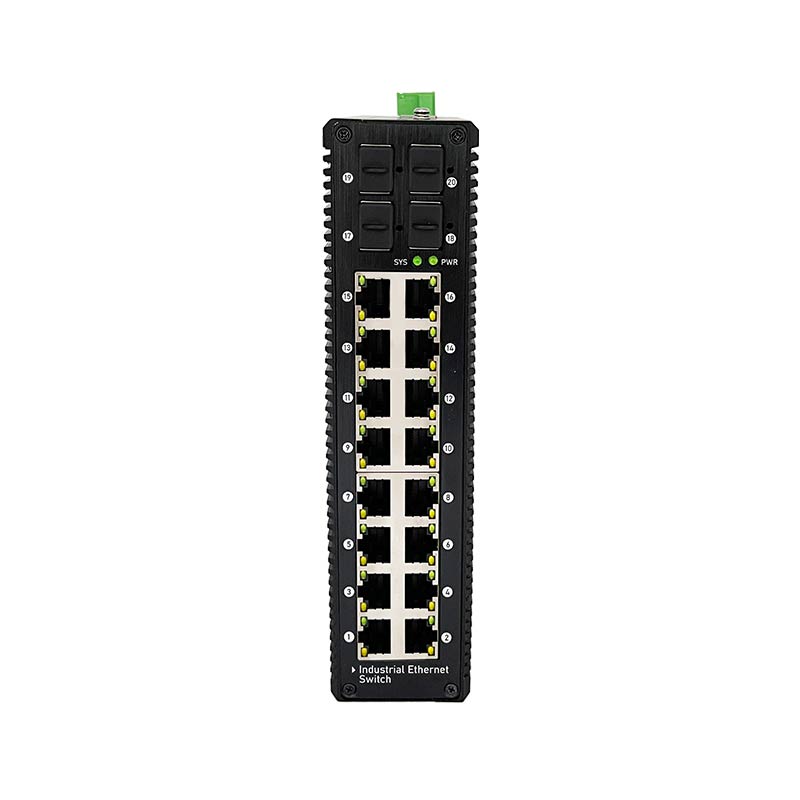
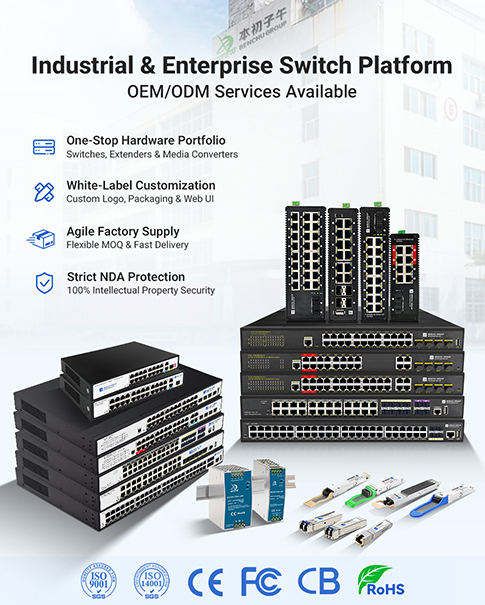
BENCHU Product Range: Benchu Group offers a complete lineup of
Enterprise-grade and Industrial-grade PoE Switches equipped with one-key DIP Extend Mode.
Explore Benchu PoE Switch Series →
2 Deploy Single or Multi-Port PoE Extenders
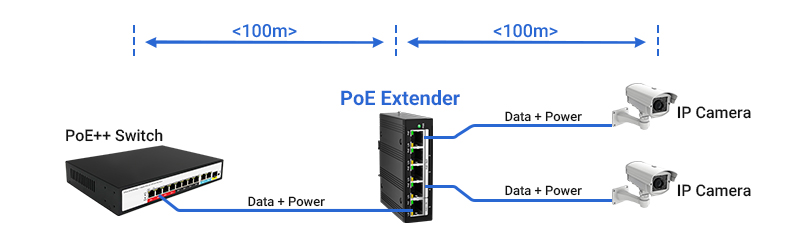
Explanation & Solution: Placed inline at 100-meter intervals, PoE extenders consume minimal energy to regenerate Ethernet data signals and pass PoE power onward. Modern extenders come in both single-port and multi-port configurations (e.g., 1 PoE input to 2 or 4 PoE outputs), allowing you to power multiple remote APs or cameras up to 500m without local AC wiring.
3 Deploy Fiber Optic Cables & Media Converters
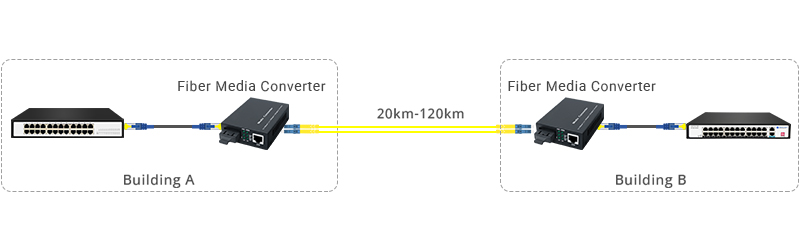
Explanation & Solution: Fiber optic cabling transmits light pulses instead of electrical signals, enabling massive distance coverage (from 550m up to 120km) with total immunity to electromagnetic interference (EMI). Media converters seamlessly convert copper RJ45 data waves into light waves.
BENCHU Product Range: Commercial & Industrial Fiber Media Converters (Fast Ethernet, Gigabit, 10G, SFP slots, and PoE transceivers).
View Fiber Converter Catalog →
4. Install an Ethernet Switch or Repeater Halfway
Placing a powered network switch midway (at 99 meters) acts as an active signal repeater. It regenerates data frames and resets the signal propagation clock, granting an additional 100 meters of transmission distance.
5. Use Wireless Ethernet Point-to-Point (P2P) Bridges
For outdoor scenarios where running physical cable is impractical or forbidden (e.g., across rivers or roadways), directional wireless bridges transmit Ethernet signals over long distances via wireless radio frequency.
6 Utilize Ethernet over Coax (EoC) Adapters
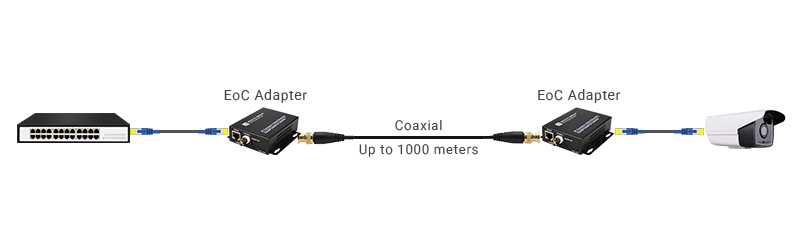
Explanation & Solution: EoC extenders utilize existing coaxial cable (RG59/RG6) to carry high-speed IP network data over long distances up to 1,000 meters. This eliminates the massive cost of re-trenching and re-cabling legacy analog systems.
BENCHU Product Range: Explore our full lineup of
Industrial EoC Transmission Kits for rapid CCTV analog-to-IP system upgrades.
View EoC Converters →
7. Network Segmentation & Routers
Segmenting long network runs with Layer 3 switches limits broadcast storms and ensures link stability over long distances.
8. Upgrade to Cat6a/Cat7 STP Cable
Thicker copper gauges (23AWG) and full shielding help minimize signal attenuation right up to the 100-meter edge.
9. Deploy VDSL2 / Ethernet Extenders
VDSL2 technology transmits Ethernet over standard 2-wire copper lines or telephone wires over distances up to 1.5 km.
10. Long-Reach Ethernet over UTP (LRE)
Specialized LRE transceivers convert IP signals to travel over single twisted-pair copper up to 1,200 meters for elevator or industrial tunnel links.

 E-Mail Us
 Call Us
 Address


 IPv6 network supported
 English