English



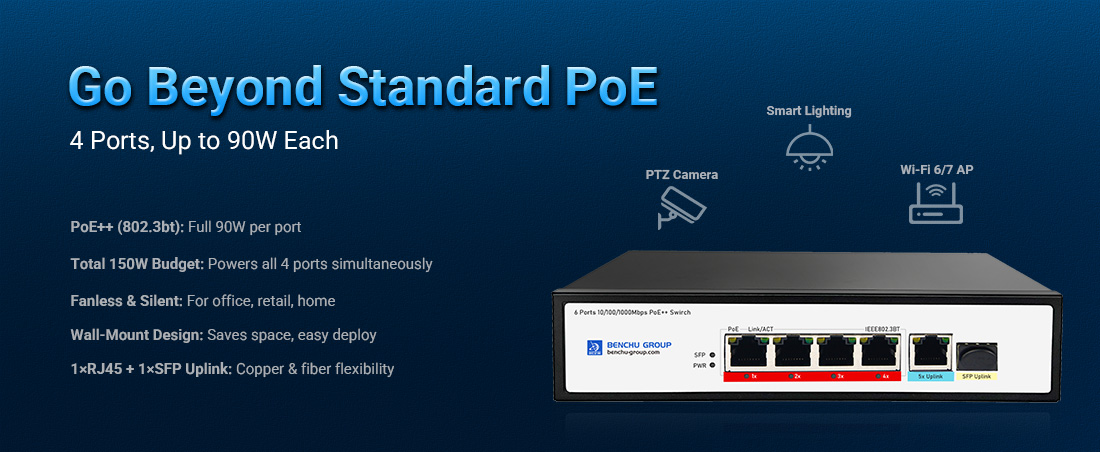
For network professionals, the evolution from traditional 15.4W PoE to the robust 90W PoE++ standard represents more than just a power increase—it’s a fundamental shift in network design philosophy. This advancement, grounded in the IEEE 802.3bt (Type 4) standard, moves us from merely connecting devices to actively powering a new generation of high-demand endpoints. As a researcher, I observe this transition enabling truly unified, efficient, and intelligent infrastructure, where a single Ethernet cable delivers both data and substantial power, transforming deployment strategies and operational capabilities across industries.
The Technical Leap: From Power Delivery to Power Enablement
The cornerstone of this transformation is the IEEE 802.3bt standard, commonly termed PoE++. Unlike its predecessors (802.3af and 802.3at), PoE++ utilizes all four twisted pairs in a standard Ethernet cable for power transmission. This technical shift allows a single port to deliver up to 90 watts from the Power Sourcing Equipment (PSE), with a guaranteed minimum of 71 watts available at the Powered Device (PD). This immense headroom is not just about raw power; it’s about stability, compatibility, and future-proofing. The standard incorporates sophisticated handshaking and classification processes (up to Class 8) to ensure safe and efficient power delivery, automatically negotiating the correct power level and protecting against faults. This intelligent power management is critical for supporting the dense, high-performance ecosystems found in modern smart enterprises and industrial Internet of Things (IIoT) applications.
Transforming Application Horizons: Beyond Cameras and Phones
The impact of high-power PoE switches is most evident in their expanded application scope. We are no longer limited to standard IP phones, cameras, or wireless access points. The 90W budget empowers a new class of connected devices:
Advanced Building Systems: Directly powering PoE lighting solutions, digital signage, and even thin clients, reducing AC wiring complexity.
High-Performance Hardware: Reliably supporting Wi-Fi 6/7 access points, pan-tilt-zoom (PTZ) surveillance cameras with heaters, and building access control systems.
Industrial and Edge Infrastructure: Enabling ruggedized computers, advanced sensors, and communication equipment in settings where separate power sources are impractical or hazardous.
This convergence of power and data on one cable drastically simplifies installation, lowers costs, and centralizes management, allowing for innovative deployments in public spaces, transportation hubs, and smart cities.
Intelligent Power Management: The Brains Behind the Brawn
Merely providing high wattage is insufficient for modern networks. The true value of next-generation PoE++ technology lies in intelligent system management. Leading switches now incorporate features that ensure reliability and optimize efficiency. For instance, AI-driven PoE systems can autonomously troubleshoot connectivity, adjust power parameters to prevent PD drop-offs, and intelligently allocate a finite total power budget across multiple ports based on predefined priorities. Furthermore, technologies like "Perpetual PoE" maintain power to critical devices even during a switch reboot, ensuring zero downtime for essential services. This smart allocation ensures that mission-critical devices always have priority, enhancing overall network resilience.
Strategic Deployment and Future Outlook
Adopting 90W PoE requires strategic planning. Key considerations include:
Switch Selection: Choosing a platform with an adequate total power budget (e.g., 360W, 480W) to support multiple ports at full load simultaneously.
Cabling Infrastructure: While Cat5e can technically support PoE++, Cat6A or better is recommended for optimal thermal performance and to support concurrent high-speed data rates like 2.5GbE, 5GbE, or 10GbE.
Future-Proofing: Selecting switches that offer a mix of high-power PoE ports and multi-gigabit or 10 Gigabit uplinks ensures the network backbone can handle increased data flow from these powerful new devices.
The trajectory is clear. As the market for PoE solutions grows significantly—driven by IoT and smart infrastructure—the demand for high-power ports will accelerate. This technology is becoming the backbone for a more connected, efficient, and intelligent world, moving us beyond simple connectivity to a paradigm of empowered integration.
 E-Mail Us
 Call Us
 Address
5F, Block5, GuangmingGu Industrial Park, Matian Villiage, Guangming Disitrict, Shenzhen, China



 IPv6 network supported