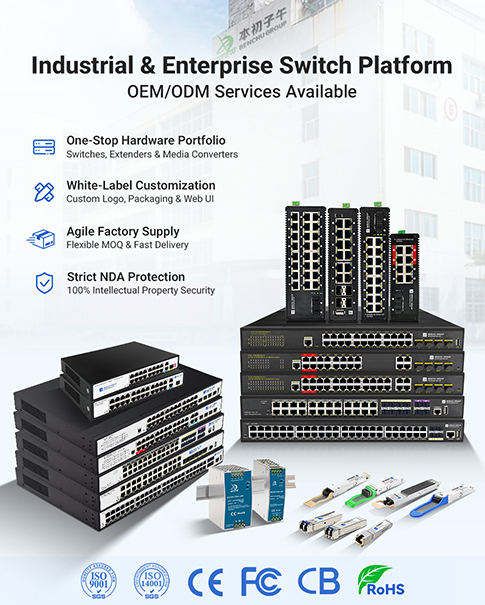
Industrial Ethernet Switch PoE

Home

Industrial Ethernet Switch PoE

  • What is the maximum temperature range for industrial switches?
    Sep 16, 2022
      Industrial PoE ethernet switch are designed to operate in extreme environments, including both very high and very low temperatures. The maximum temperature range for industrial switches typically spans from -40°C to +75°C (-40°F to +167°F), although some specialized models can operate in even broader temperature ranges, depending on the specific design and intended application.Here’s a detailed description of the temperature ranges and factors involved:   1. Typical Temperature Range for Industrial Switches Most industrial switches are rated for a temperature range of -40°C to +75°C (-40°F to +167°F). This wide range makes them suitable for various industrial and outdoor applications where environmental control is limited, and temperature fluctuations are common. The ability to handle both freezing and extremely hot conditions makes them ideal for use in industries such as: --- Outdoor telecommunications --- Smart city infrastructure --- Mining and oil & gas industries --- Transportation systems (railways, roadways, marine) --- Manufacturing plants --- Utilities (wind farms, substations, solar energy systems) These switches are often placed in environments such as outdoor cabinets, control rooms without air conditioning, or inside heavy machinery, where temperature fluctuations can be intense.     2. Extended Temperature Range Switches For even more extreme environments, certain industrial switches are specifically designed with an extended temperature range. These models can tolerate temperatures ranging from -40°C to +85°C (-40°F to +185°F) or more. Some highly specialized models can operate at temperatures even higher, although this is less common. High-Temperature Applications: Industrial switches used in desert climates, near industrial furnaces, or in environments like oil and gas plants may need to endure temperatures that exceed the standard +75°C. These high-temperature models are engineered with enhanced heat dissipation mechanisms and often feature fanless designs to reduce the risk of mechanical failure in hot environments. Low-Temperature Applications: Switches deployed in cold environments like arctic regions, mountaintop communication stations, or cold storage facilities need to handle temperatures well below freezing. These switches incorporate special materials and designs to ensure that cold conditions do not cause brittleness or affect performance.     3. Cooling and Thermal Management For switches operating at the upper end of the temperature spectrum, effective thermal management is crucial to ensure long-term reliability and performance. Industrial switches designed for high temperatures include features such as: Fanless Designs: Many industrial switches designed for harsh conditions use passive cooling methods (i.e., heat sinks or airflow designs) rather than active cooling (i.e., fans) to minimize mechanical parts that could fail in dusty or dirty environments. Enhanced Airflow: Some switches are built with larger, more ventilated enclosures or metal casings that improve heat dissipation and prevent the device from overheating, even in direct sunlight or enclosed spaces. Wide Operating Voltage: To help manage power more efficiently and avoid overheating, some industrial switches are designed to operate with a wide range of voltage inputs, which ensures they can maintain stable performance in areas with power fluctuations or surges.     4. Environmental Impact on Lifespan and Performance While outdoor industrial switches can tolerate extreme temperatures, prolonged exposure to such conditions can still impact their lifespan. For example: High Temperatures: Prolonged exposure to high temperatures can gradually degrade internal components, leading to a reduced overall lifespan, especially if the switch is operating near its upper temperature limit for extended periods. Heat increases the wear and tear on electronic components and can lead to thermal stress if not adequately managed. Low Temperatures: Extremely low temperatures can cause materials to become brittle, affecting connectors, seals, and other parts of the switch. This is especially relevant in applications where mechanical vibrations are present, as cold conditions can make materials more susceptible to cracking or wear. To address this, manufacturers often rate their switches for a derated lifespan when operating at the extreme ends of their temperature ranges. In other words, a switch operating at maximum temperature conditions (e.g., +75°C or higher) may have a shorter lifespan than one operating under more moderate conditions.     5. Specialized Certifications for High-Temperature Switches Many industrial switches designed for extreme temperature environments also meet specialized certifications that validate their performance in such conditions. For example: ATEX or UL Class 1 Division 2: Certifications like ATEX or UL Class 1 Division 2 certify that industrial switches are safe to use in hazardous environments with extreme temperatures, such as in the presence of explosive gases, dust, or chemicals. MIL-STD-810G: Some ruggedized switches meet military standards for operating in extreme temperatures, ensuring their performance in demanding environments such as military installations or aerospace applications.     6. Applications for Maximum Temperature Ranges Industrial ethernet switch PoE with wide temperature ranges are commonly used in the following applications: Energy and Utilities: Power plants, substations, and solar/wind energy systems are often located outdoors or in remote areas where temperature extremes are common. Industrial switches in these environments need to ensure continuous connectivity even during heat waves or cold snaps. Transportation: Railways, highways, and shipping ports require robust network infrastructure. Switches used in these sectors may be housed in outdoor enclosures exposed to the elements or in onboard systems that experience wide temperature fluctuations. Mining and Oil & Gas: Industrial switches are often deployed in remote mining sites, oil rigs, and processing plants where temperature extremes (both hot and cold) are frequent. Outdoor Surveillance: Many outdoor IP cameras, wireless access points, and sensors in surveillance systems are powered and connected through industrial switches. These are often located in unprotected areas and exposed to fluctuating environmental conditions.     Conclusion The maximum temperature range for most industrial switches is typically between -40°C to +75°C (-40°F to +167°F), but extended temperature models can function in ranges reaching -40°C to +85°C (-40°F to +185°F) or more. These switches are designed with rugged materials, thermal management systems, and durable enclosures to operate reliably in harsh outdoor environments, extreme heat, or freezing temperatures. The specific temperature range required will depend on the application and environmental conditions in which the switch will be deployed.    
    Read More
  • How do industrial switches handle power fluctuations?
    Sep 19, 2022
      Industrial switches are designed to handle power fluctuations efficiently to ensure continuous, reliable operation in environments where electrical disturbances such as surges, voltage drops, and power outages are common. Power fluctuations can be a significant challenge in industrial settings, but various features and mechanisms are incorporated into industrial switches to mitigate the risks associated with unstable power.Here’s a detailed description of how industrial switches handle power fluctuations:   1. Redundant Power Inputs One of the primary ways industrial switches handle power fluctuations is through redundant power inputs. These inputs allow the switch to be connected to two independent power sources, such as two separate power supplies or different circuits. If one power source fails or fluctuates, the switch seamlessly switches to the secondary power input without interrupting network operation. This is particularly useful in critical applications where downtime is not acceptable. Dual Power Inputs: Most industrial switches feature dual or multiple power inputs that provide a backup in case one power source is disrupted. The switch can automatically detect a failure in the primary input and switch to the secondary one without the need for manual intervention. Load Sharing: In some advanced models, both power supplies can operate simultaneously, sharing the load. This ensures the switch continues functioning even if one power source weakens but doesn’t completely fail.     2. Uninterruptible Power Supply (UPS) Compatibility Industrial switches are often designed to be compatible with uninterruptible power supply (UPS) systems. A UPS provides backup power in the event of a power failure, allowing the switch and other critical equipment to keep running temporarily. This is particularly important in industries where any downtime can lead to significant operational disruption or safety hazards, such as: --- Data centers --- Manufacturing plants --- Utility and energy facilities The UPS gives the system enough time to either restore power or safely shut down devices to avoid damage.     3. Power over Ethernet (PoE) Many industrial ethernet switch PoE support Power over Ethernet (PoE), which allows both data and power to be delivered to network devices (e.g., IP cameras, wireless access points, sensors) over a single Ethernet cable. In case of power fluctuations, PoE switches often have built-in safeguards to ensure continuous power delivery and avoid overloading the system. PoE Budgeting: Industrial PoE switches allocate power efficiently to connected devices by monitoring the power demand. When fluctuations or outages occur, the switch can prioritize critical devices to receive power, ensuring the most important systems stay operational. PoE Redundancy: Some PoE switches offer redundancy in their power supply units (PSU) to ensure that connected devices (like surveillance cameras or access points) don’t lose power, even if the primary power source experiences fluctuations.     4. Surge Protection One of the most important protections against power fluctuations, especially in outdoor or industrial environments, is surge protection. Power surges can be caused by lightning strikes, electrical switching events, or faulty equipment in the electrical grid. Industrial switches are built with surge protection mechanisms to absorb and dissipate excess energy, preventing damage to the switch and connected devices. Integrated Surge Protectors: Many industrial switches have built-in surge protection on their power inputs and network ports. This protects against voltage spikes that could otherwise damage sensitive electronic components. Surge protection typically ranges between 2kV to 6kV, depending on the switch’s design and intended use. Ethernet Port Protection: Surge protection extends to Ethernet ports, especially in outdoor applications where network cables can act as conduits for electrical surges. Protecting these ports helps prevent damage to connected devices like cameras, sensors, or wireless access points.     5. Wide Voltage Range Support Industrial switches are often designed to accept a wide input voltage range, which allows them to continue operating even when the supply voltage fluctuates beyond the normal operating limits. This feature makes them more resilient to common power disturbances, such as brownouts (voltage dips), which can cause regular commercial switches to malfunction. Wide Voltage Tolerance: Some industrial switches can handle voltage ranges from 12V DC to 48V DC, or even wider ranges like 9V DC to 60V DC. This flexibility allows them to adapt to varying power conditions in different industrial settings, such as remote locations with unstable power grids or environments powered by generators or solar panels. AC and DC Power Support: Many industrial switches can support both alternating current (AC) and direct current (DC) power inputs, making them suitable for a variety of industrial applications. They can be connected to a range of power sources, from typical electrical grids to industrial battery systems.     6. Power Conditioning Features Industrial switches often come with built-in power conditioning features that stabilize incoming power. This is particularly important in environments with unstable power, where voltage can spike or drop suddenly. These features include: Voltage Regulation: Ensures the internal circuits receive a stable voltage even when there are fluctuations in the external power supply. Voltage regulation prevents the components from being exposed to voltages that are too high (which could cause damage) or too low (which could cause malfunctions). Filtering of Electrical Noise: Industrial settings often have heavy machinery that generates electrical noise, which can affect the performance of network switches. Power conditioning features filter out this noise to maintain consistent performance.     7. Fail-Safe Mechanisms Industrial switches are often deployed in critical applications where network downtime can have serious consequences. To address this, many industrial switches incorporate fail-safe mechanisms to ensure that the network continues to operate, even in the event of power fluctuations or interruptions. Bypass Relays: Some industrial switches have bypass relays that allow network traffic to continue to flow through the switch even if the switch itself loses power. This ensures that communication between devices on the network is not interrupted, providing a fail-safe in case of power failure. Auto Recovery Protocols: Industrial switches are often equipped with redundancy protocols like Rapid Spanning Tree Protocol (RSTP) or Ethernet Ring Protection Switching (ERPS) that allow the network to recover quickly from any disruptions. In case of a power outage, the switch can quickly reconnect to the network once power is restored.     8. Smart Power Management Some advanced industrial switches feature smart power management technologies that monitor the power consumption of both the switch and the connected devices. These systems can detect abnormal power usage and make adjustments to avoid system overload or malfunction. Smart power management features include: Dynamic Power Allocation: This allocates power to devices based on their priority, ensuring that critical devices (like safety systems or main control points) maintain power even in low-power situations. Power Monitoring and Alarming: Many industrial switches include power monitoring tools that provide real-time data on power consumption and issue alerts if power fluctuations or anomalies are detected. This allows operators to respond proactively before a critical issue arises.     Conclusion Industrial PoE ethernet switch are equipped with a variety of features to handle power fluctuations, ensuring they operate reliably in environments with unstable power conditions. Key mechanisms include redundant power inputs, surge protection, wide voltage tolerance, and power conditioning features. These switches also often integrate fail-safe mechanisms and smart power management to ensure continuous operation and minimize downtime. The ability to withstand voltage spikes, dips, and outages makes industrial switches essential for critical applications in industries such as manufacturing, transportation, energy, and telecommunications.    
    Read More

leave a message

leave a message
If you are interested in our products and want to know more details,please leave a message here,we will reply you as soon as we can.
submit

home

products

WhatsApp

Contact Us