 English



A Time-Sensitive Networking (TSN) switch supports specified IEEE 802.1 mechanisms for time synchronization, scheduled traffic, or other time-sensitive networking functions. A conventional managed Ethernet switch typically provides network management, VLAN segmentation, Quality of Service (QoS), and traffic monitoring.
For industrial automation OEMs, system integrators, and network engineers, understanding the difference helps determine whether conventional managed switching is sufficient or whether a network requires additional TSN capabilities.
Quick Answer: TSN Switch vs. Managed Ethernet Switch
A managed Ethernet switch provides configurable network management and traffic control. A TSN-capable switch implements specific mechanisms for requirements such as synchronized time and scheduled traffic, depending on the product.
- Choose a conventional managed switch when VLANs, QoS, monitoring, segmentation, and standard Ethernet connectivity meet the application requirements.
- Evaluate a TSN switch when the application requires coordinated timing, scheduled traffic, or other specific TSN mechanisms.
- Verify the complete network because predictable end-to-end behavior depends on device capabilities, configuration, traffic planning, and interoperability.
TSN and managed Ethernet are not mutually exclusive categories. A TSN switch can also provide conventional management features, but not every managed Ethernet switch supports the TSN functions required by a particular application.
1. What Is the Difference Between a TSN Switch and a Managed Ethernet Switch?
NETWORK MANAGEMENT
What Is a Managed Ethernet Switch?
A managed Ethernet switch allows administrators to configure and monitor network behavior through a web interface, command-line interface, or network management software. Depending on the model, features may include VLANs, QoS, port mirroring, access control lists, multicast management, and network redundancy.
These functions help segment traffic, prioritize selected packets, control network access, and simplify troubleshooting. Industrial managed switches may also offer DIN-rail mounting, redundant power inputs, wide-temperature operation, and industrial network recovery features.
Management capability alone does not confirm support for time-aware traffic scheduling, synchronized clocks, or other TSN mechanisms.
TIME-SENSITIVE NETWORKING
What Is a TSN Switch?
A TSN switch is an Ethernet bridge or switch that implements one or more applicable Time-Sensitive Networking mechanisms standardized by IEEE 802.1. Depending on the product, these may address time synchronization, scheduled traffic, frame preemption, or frame replication and elimination.
TSN is a collection of standards and mechanisms, not a single feature that every product implements in the same way. Engineers should verify supported standards, configuration options, and interoperability requirements.
2. TSN Switch vs. Managed Ethernet Switch: Feature Comparison
Compare conventional management features with representative TSN mechanisms. Actual capabilities vary by model and implementation.
| Feature | Conventional Managed Ethernet Switch | TSN-Capable Switch |
|---|---|---|
| VLAN segmentation | Commonly supported, depending on model. | Can be supported alongside TSN mechanisms. |
| QoS and priority queues | Commonly used to classify and prioritize traffic. | Can combine priority handling with supported TSN mechanisms. |
| Time synchronization | Not implied by management capability alone. | May support IEEE 802.1AS/gPTP or other specified timing functions. |
| Time-aware scheduling | Standard QoS does not imply time-aware scheduling. | IEEE 802.1Qbv can schedule transmission using time-aware gates. |
| Frame preemption | Not implied by ordinary managed-switch features. | IEEE 802.1Qbu can support frame preemption when the necessary functionality is implemented and configured. |
| Frame replication and elimination | Not implied by conventional switching. | IEEE 802.1CB can support frame replication and elimination for reliability. |
| Network management | Features depend on the model. | May combine conventional management with TSN-specific configuration functions. |
| Industrial environmental protection | Must be checked in the product specifications. | Must also be checked separately; TSN support does not automatically imply wide-temperature operation or surge protection. |
Key takeaway: A conventional managed switch may support VLANs and QoS, but these features alone do not confirm support for TSN timing, scheduled traffic, frame preemption, or frame replication and elimination.
Important: Support for one TSN mechanism does not establish support for every TSN standard. A switch with time-synchronization capability may not support the scheduled-traffic or redundancy functions required by a specific application.
3. Why QoS Alone May Not Be Enough for Real-Time Industrial Networks
QoS and TSN address related but different networking requirements. QoS helps classify traffic and assign forwarding priorities. TSN mechanisms can add synchronized timing and coordinated transmission behavior when required by the application.
TRAFFIC PRIORITIZATION
What QoS Can Do
A managed switch can assign different priorities to traffic classes. For example, control messages can receive higher priority than routine monitoring data or large file transfers. This helps the switch handle competing traffic more effectively.
TIME-AWARE NETWORKING
What TSN Adds
Depending on the supported standards, TSN can add clock synchronization, time-aware transmission scheduling, frame preemption, or frame replication and elimination.
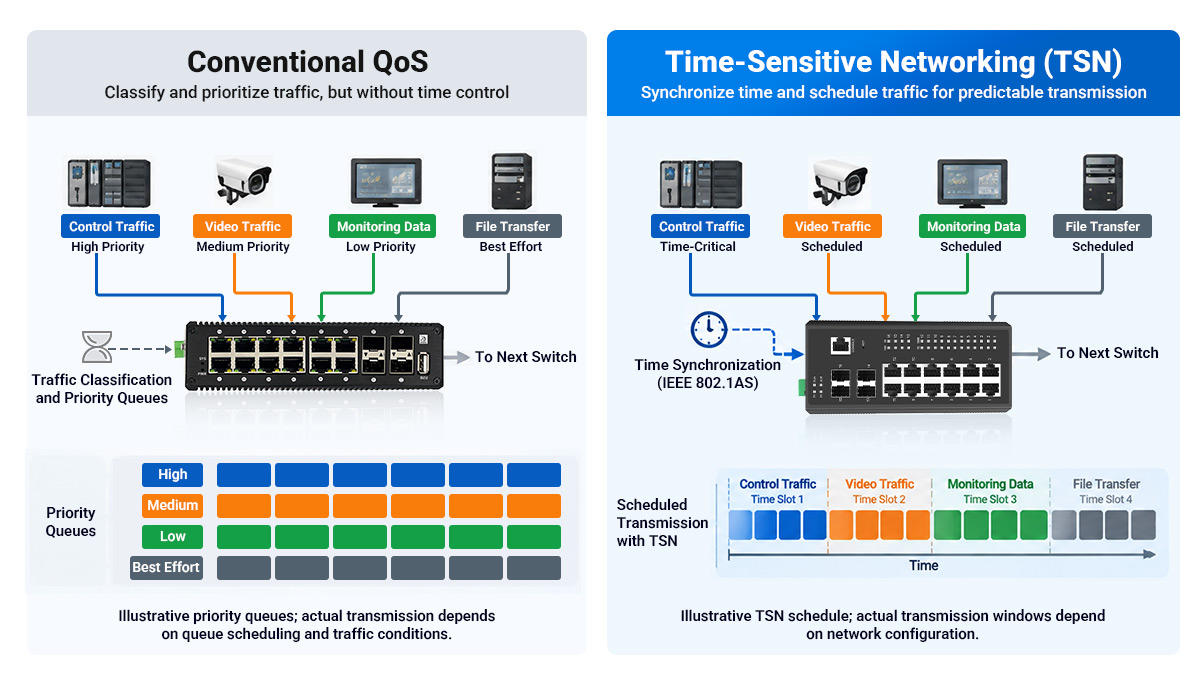
Choose mechanisms based on the application. These standards address different requirements and are not all necessary in every TSN deployment. The appropriate combination depends on traffic patterns, synchronization requirements, latency and jitter limits, redundancy objectives, and the selected network profile.
TSN does not automatically guarantee zero latency or zero packet loss. Predictable end-to-end behavior requires appropriate network design, compatible devices, correct configuration, and validation against the application's requirements.
4. When Should You Choose a TSN Switch?
OPTION 01
When a Conventional Managed Ethernet Switch May Be Sufficient
- Machine monitoring and general industrial data collection.
- Network segmentation using VLANs and access controls.
- Applications where conventional QoS meets the required traffic performance.
- Industrial networks that need management, diagnostics, and redundancy without requiring TSN-specific timing or scheduling.
OPTION 02
When a TSN Switch Is Worth Evaluating
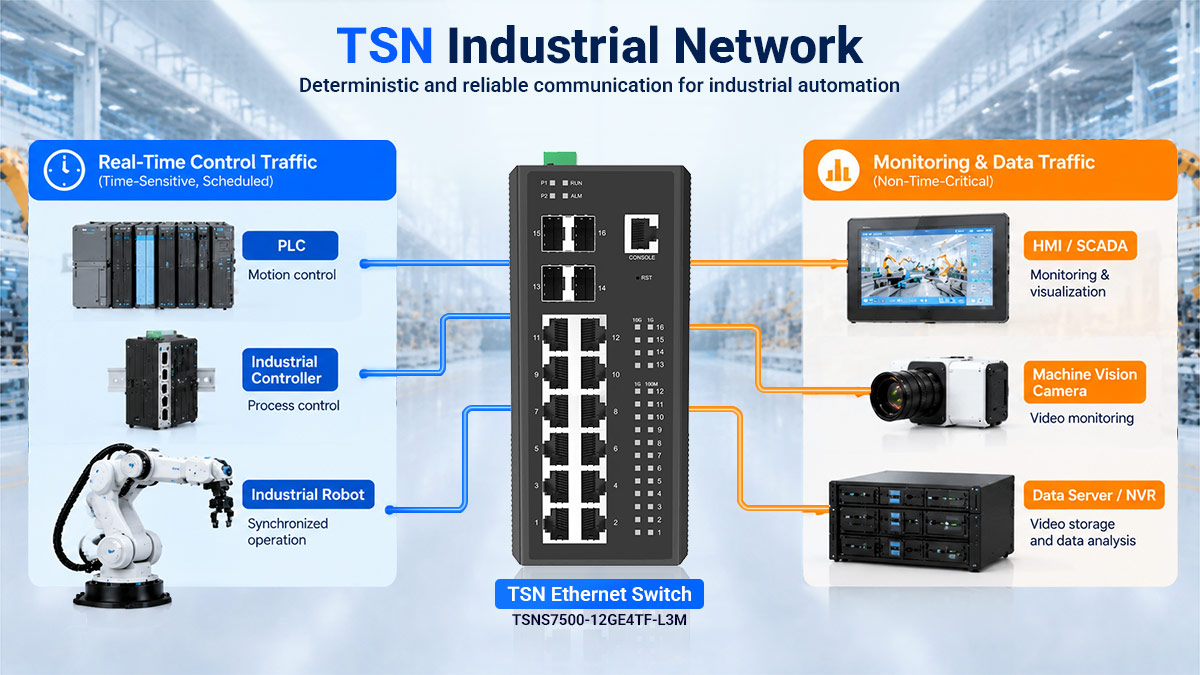
- Coordinated automation: Multiple devices need synchronized communication with defined timing requirements.
- Mixed critical and non-critical traffic: Control traffic shares infrastructure with other data streams and requires scheduled transmission.
- Time-sensitive control: The application has defined latency, jitter, or synchronization requirements that must be addressed by the network design.
- Industrial network convergence: Different traffic types share Ethernet infrastructure while requiring controlled communication behavior.
TSN is not automatically a replacement for every existing industrial protocol or real-time Ethernet architecture. The selection should be based on measurable application requirements, compatibility, and the capabilities of the complete network.
5. TSN Switch Selection Checklist for Industrial Networks
01 / TIMING
Define timing requirements. Establish cycle time, latency, jitter, synchronization accuracy, and acceptable traffic loss.
02 / STANDARDS
Identify required standards. Determine whether the design needs IEEE 802.1AS, 802.1Qbv, 802.1Qbu, 802.1CB, or other applicable mechanisms.
03 / CONFIGURATION
Check configuration capabilities. Confirm how synchronization, schedules, traffic parameters, and monitoring are configured.
04 / COMPATIBILITY
Validate interoperability. Check that endpoints, switches, timing sources, and intermediate devices support the required functions.
05 / PORTS & UPLINKS
Verify ports and uplinks. Consider copper and fiber connectivity, port speeds, uplink capacity, and expected traffic volume.
06 / ENVIRONMENT
Assess industrial conditions. Verify operating temperature, power input, mounting, enclosure, EMC, surge protection, and environmental requirements.
07 / REDUNDANCY
Plan redundancy. Confirm whether the application needs network redundancy and whether the selected mechanisms are compatible with the design.
08 / VALIDATION
Test the complete configuration. Validate synchronization, scheduled traffic, congestion behavior, failover, and recovery against acceptance criteria.
6. Recommended Industrial Networking Switches from Benchu
Choose a switch according to the network's timing requirements, port configuration, uplink bandwidth, and industrial deployment conditions. The products below serve different networking requirements; confirm the specifications needed for your application before selection.
1. TSN SWITCH
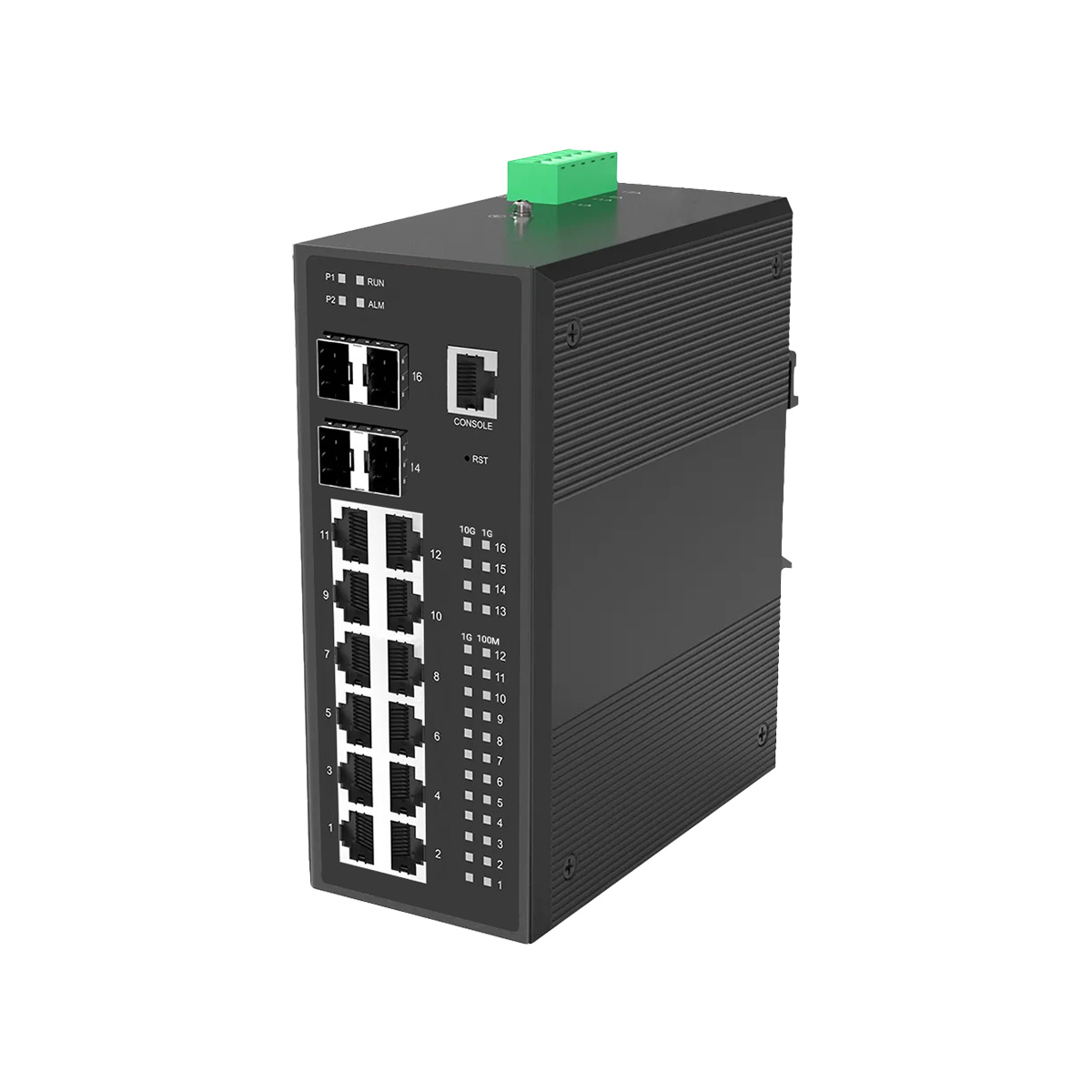
TSNS7500-12GE4TF-L3M
16-Port Gigabit TSN Switch with 4 × 10G SFP+ Uplinks
Designed for industrial networks that require TSN-related capabilities, Gigabit connectivity, high-speed fiber uplinks, and Layer 3 networking. Review the model's supported TSN mechanisms and configuration options to determine whether they meet your real-time application requirements.
View Detail →2. INDUSTRIAL MANAGED POE SWITCH
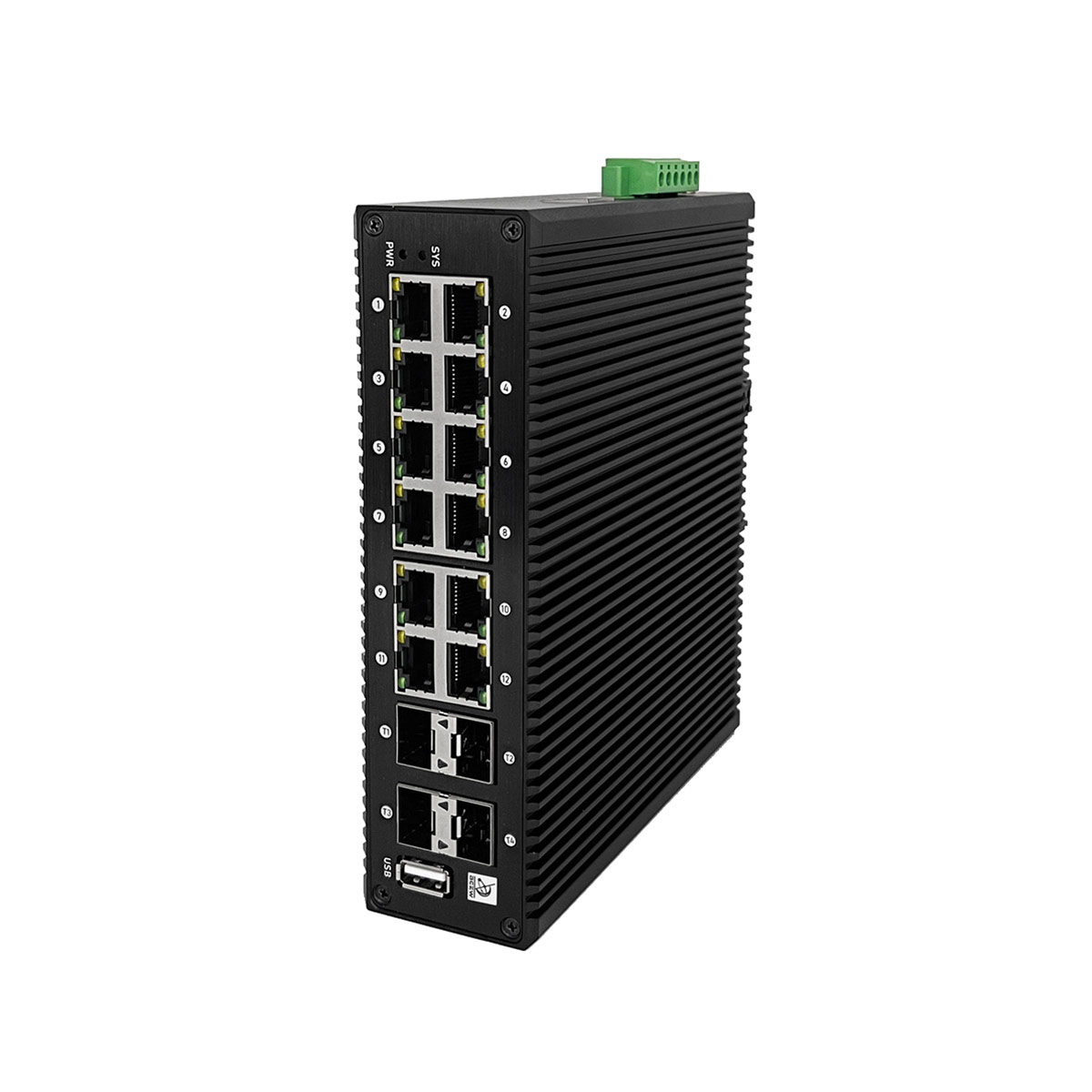
IES7511-8PGE4GE4TF-DC
8-Port Gigabit Managed Industrial PoE+ Switch with 4 × 1G RJ45 and 4 × 10G SFP+ Uplinks
A managed industrial switch for applications that need PoE+ device connectivity, copper uplinks, and high-speed fiber aggregation. It supports eight PoE+ ports, four additional Gigabit RJ45 ports, and four 1G/2.5G/10G SFP+ uplinks.
View Detail →The IES7511-8PGE4GE4TF-DC is presented here as an industrial managed PoE+ option for conventional managed Ethernet applications. Its inclusion does not imply that it supports the TSN mechanisms discussed in this article. Confirm the exact standards and capabilities of each product against its official documentation.
7. Frequently Asked Questions
1. Can a Managed Ethernet Switch Support TSN?
Yes, if its hardware, software, and implementation provide the relevant TSN mechanisms. VLAN and QoS support alone do not demonstrate compatibility with all TSN functions. Verify the specific standards and configuration options supported by the product.
2. What Is the Difference Between QoS and TSN?
QoS commonly classifies traffic and assigns forwarding priorities. TSN includes mechanisms such as time synchronization and time-aware scheduling to address additional timing requirements. The two can work together, but they are not interchangeable.
3. Does Every TSN Switch Support All IEEE TSN Standards?
No. TSN is a collection of standards and mechanisms. Check the specific functions required by the application and confirm that the switch implements and supports them.
4. When Should I Choose a TSN Switch Instead of a Managed Ethernet Switch?
A conventional managed switch may be sufficient when VLANs, QoS, monitoring, and standard connectivity meet the application's needs. Evaluate a TSN switch when the application requires specific synchronization, scheduled traffic, or other TSN mechanisms.
BENCHU / OEM & ODM NETWORKING SOLUTIONS
Need a Switch for Your Industrial Networking Project?
Selecting an industrial switch involves more than port count and bandwidth. Your project may also require specific TSN functions, fiber uplinks, network management features, PoE power, or customized product specifications.
Contact BENCHU to discuss your requirements for:
- TSN switch specifications and technical documentation
- Port configuration and 10G SFP+ uplink requirements
- Industrial PoE+ switch specifications
- OEM/ODM and private-label opportunities
Share your target application, required interfaces, and preferred functions so the team can help review the relevant product specifications.
Technical note: Confirm all product specifications and standards claims against the current official product datasheet before publication.
 E-Mail Us
 Call Us
 Address


 IPv6 network supported