Unmanaged PoE Switch

Home

Unmanaged PoE Switch

  • Do I Need a Managed or Unmanaged PoE Switch?
    Feb 14, 2025
    When setting up a network, the decision between a managed PoE switch and an unmanaged PoE switch is crucial. Both provide Power over Ethernet (PoE), but the level of control and features they offer differs significantly. What is a Managed PoE Switch? A managed PoE switch offers advanced control over your network. It allows for configuration, monitoring, and optimization of network traffic. These switches often include features like VLAN support, Quality of Service (QoS), and port management, making them suitable for larger, more complex networks. Managed PoE switches can also provide PoE+ or even PoE++ power, supporting power-hungry devices like IP cameras and access points. What is an Unmanaged PoE Switch? An unmanaged PoE switch is simpler and requires no configuration. It automatically provides power and data to connected devices without any user input. While these switches lack advanced features, they are ideal for smaller, less complex networks where plug-and-play functionality is sufficient. Key Differences Between Managed and Unmanaged PoE Switches 1. Network Control Managed PoE switches offer network control, such as the ability to configure VLANs, prioritize traffic, and monitor network performance. Unmanaged switches are simpler, with no configuration options. 2. Security Managed switches offer enhanced security features like port security and network segmentation. Unmanaged switches have minimal security, making them suitable for less sensitive environments. 3. Power Management Managed PoE switches often provide more power options, supporting higher power outputs like PoE++ for power-hungry devices. They also allow for more efficient power usage, which is ideal for large networks. Unmanaged switches, however, typically provide standard PoE power levels without flexibility. 4. Scalability Managed switches are scalable, making them ideal for growing networks. Unmanaged switches are best for static networks with fewer devices. When to Choose a Managed PoE Switch? If you need more control over network performance, security, and scalability, a managed PoE switch is the best choice. It’s ideal for enterprises, smart buildings, or networks with devices that require advanced management. When to Choose an Unmanaged PoE Switch? For small networks with basic needs, an unmanaged PoE switch is often sufficient. These are best for home offices or small businesses where simplicity and cost-effectiveness are key.   Choosing between a managed and unmanaged PoE switch depends on your network's size, complexity, and requirements. Managed switches offer advanced features for larger networks, while unmanaged switches provide a simple, cost-effective solution for smaller setups.
    Read More
  • What is the best PoE solution for VoIP phones?
    Sep 10, 2021
      The best Power over Ethernet (PoE) solution for VoIP phones depends on the size of your deployment, network infrastructure, and specific requirements such as scalability, power needs, and management capabilities. Below are the recommended solutions and factors to consider for choosing the ideal PoE setup for VoIP phones.   Key Factors to Consider: 1.Number of Devices: The number of VoIP phones you need to support will influence whether you choose a small PoE injector or a fully managed PoE switch. 2.Power Requirements: VoIP phones typically require minimal power, but you’ll want to ensure your PoE solution provides enough wattage per port to support any additional features, like integrated video conferencing or color displays. 3.Network Management: Managed PoE switches offer enhanced network monitoring, control, and security features, which are important for enterprise environments with complex networks. 4.Scalability: Ensure the PoE solution can scale with your future network needs as you add more phones or devices.     PoE Solutions for VoIP Phones: 1. PoE Switches (Managed or Unmanaged) PoE switches are the most common and versatile solution for VoIP phones. They provide both power and data connectivity through Ethernet cables, streamlining installation and reducing costs. Managed PoE Switch: This is the ideal solution for larger deployments or enterprises where network monitoring, power allocation, and traffic prioritization are important. Managed switches allow you to monitor network traffic, set up VLANs for security, and remotely manage power distribution to VoIP phones. Benefits: --- Centralized control of all VoIP devices. --- Ability to configure QoS (Quality of Service) for VoIP traffic, ensuring call quality. --- Remote management and monitoring of network performance. --- Future scalability with easy addition of more devices. Examples: Cisco Catalyst 2960 Series, Ubiquiti UniFi Switches, Netgear ProSAFE Series,Benchu Group  SP7500 Series.   Unmanaged PoE Switch: For small or simple networks, an unmanaged PoE switch can provide power to VoIP phones without the need for advanced configuration. These switches are plug-and-play, requiring no setup. Benefits: --- Cost-effective for small offices or simple VoIP deployments. --- Easy to use, with no configuration required. Examples: Netgear GS305P, D-Link DES-1005P,Benchu Group SP5200-4PFE2FE.   2. PoE Injectors PoE injectors are standalone devices that inject power into Ethernet cables for individual VoIP phones. They are ideal when you only need to power a few VoIP phones and don’t want to invest in a full PoE Ethernet Switches. Benefits: --- Great for small deployments where only a few VoIP phones need power. --- No need to replace your existing non-PoE switch. --- Simple and cost-effective for small businesses or home offices. Examples: Ubiquiti Networks POE-24-12W, Benchu Group PSE102-GE, TRENDnet TPE-115GI.   3. PoE Midspans PoE midspans are devices that sit between your non-PoE switch and your VoIP phones. They add PoE functionality to a standard Ethernet network without the need to replace the existing switch. Benefits: --- Allows you to upgrade to PoE without replacing existing switches. --- Ideal for businesses that already have a robust network infrastructure. Examples: Phihong POE29U-1AT, Microsemi PD-9001GR , Benchu Group PSE102.     Additional Considerations: 1. PoE Standards --- PoE (IEEE 802.3af): Delivers up to 15.4W per port, which is more than sufficient for most VoIP phones. This is the most common standard used for powering VoIP phones. --- PoE+ (IEEE 802.3at): Delivers up to 30W per port, useful if your VoIP phones have advanced features like video displays or are combined with other devices like cameras or wireless access points. --- Ensure that your switch or injector supports the PoE standard that matches your VoIP phones' power requirements.   2. QoS (Quality of Service) --- For VoIP phones, ensuring call quality is critical. Managed PoE switches allow you to configure QoS settings to prioritize voice traffic over other data traffic, ensuring clear, uninterrupted calls even in busy networks.   3. Network Security --- Managed PoE switches allow you to configure VLANs (Virtual Local Area Networks) to isolate VoIP traffic from the rest of your network. This adds an extra layer of security and ensures that voice traffic is not disrupted by other network activities.     Recommended Solutions Based on Deployment Size: 1.Small Deployment (1-5 VoIP Phones): Solution: Use PoE injectors or a small unmanaged PoE switch. Recommended Models: --- Unmanaged PoE Switch: Netgear GS305P or Benchu Group SP5200-4PFE2FE.   2.Medium Deployment (5-24 VoIP Phones): Solution: Use an unmanaged or managed PoE switch depending on the need for network control and scalability. Recommended Models: --- Managed PoE Switch: Ubiquiti UniFi Switch 24 PoE, Benchu Group SP7500-24PGE4GC, Cisco SG350-28P. --- Unmanaged PoE Switch: Netgear GS110TP or Benchu Group SP5220-24PGE4GC.   3.Large Deployment (25+ VoIP Phones): Solution: A managed PoE switch with advanced features like VLAN support, QoS, and remote management for large office environments. Recommended Models: Cisco Catalyst 2960 Series,Benchu Group SP7500-48PGE4TF, HP ProCurve 2920, or Aruba 2930F.     Conclusion: For small deployments, a PoE injector or a basic unmanaged PoE switch is sufficient. For larger or growing VoIP deployments, a managed PoE switch offers scalability, control, and advanced features like traffic prioritization and monitoring. Choosing a solution with the right power standard (PoE or PoE+) and management capabilities will ensure your VoIP phones function reliably while keeping costs manageable.    
    Read More
  • What is the best PoE solution for small businesses?
    Sep 14, 2023
      The best Power over Ethernet (PoE) solution for small businesses depends on the specific needs of the network, such as the number of devices, the type of devices (IP cameras, VoIP phones, wireless access points), and power requirements. Here are some key factors and recommended options to consider when choosing a PoE solution for small businesses:   1. Number of Ports Small Network (5–10 devices): A 8-port or 12-port PoE switch is typically sufficient. These switches offer enough connectivity for basic setups like IP cameras, VoIP phones, and a few wireless access points. Medium-Sized Network (10–30 devices): A 24-port PoE switch offers more scalability and supports more devices in an expanding network.     2. PoE Standards --- PoE (802.3af): Provides up to 15.4W of power per port. Suitable for low-power devices like VoIP phones and simple IP cameras. --- PoE+ (802.3at): Provides up to 30W per port. Ideal for higher-power devices such as advanced IP cameras, wireless access points, and video conferencing systems. --- PoE++ (802.3bt): Provides up to 60W or 100W per port. This is more suitable for power-hungry devices, like PTZ (Pan-Tilt-Zoom) cameras, LED lighting, or digital displays. For most small businesses, PoE+ (802.3at) is sufficient for supporting typical devices like IP cameras and Wi-Fi access points.     3. Managed vs. Unmanaged Switches Managed PoE Switch: Provides more control and features such as VLANs, traffic prioritization (QoS), remote monitoring, and power management. It is ideal for small businesses that need control over their network and plan for future expansion. Unmanaged PoE Switch: A simpler plug-and-play solution, without the need for advanced configurations. Best for small networks with basic needs. Recommendation: For flexibility and long-term growth, a managed switch is a better choice for small businesses, especially if you plan to add more devices over time.     4. Power Budget --- Ensure that the switch has enough total power budget to support all your PoE devices. For example, if you are using PoE+ devices, and each requires 25W, and you have 10 devices, the switch should have a power budget of at least 250W to avoid overloads.     5. Brand Reliability and Support Ubiquiti UniFi: Offers affordable and scalable managed PoE switches that integrate well with UniFi devices such as access points and cameras. Great for small businesses that want an all-in-one ecosystem. Cisco Small Business Series: Known for robust security features, Cisco’s small business switches are reliable and come with excellent support and warranty. TP-Link Omada: A cost-effective solution with both managed and unmanaged PoE switches, ideal for small businesses on a budget. Netgear: Offers a wide range of switches, including both managed and unmanaged PoE models, with strong reliability and easy-to-use interfaces.     6. Scalability --- If you expect your business to grow, choose a switch that can accommodate additional devices or offers stacking capabilities for adding more switches in the future.     Suggested PoE Switches for Small Businesses: 1.Ubiquiti UniFi Switch US-8-150W --- 8 PoE+ ports, 150W power budget, managed via the UniFi Controller, and suitable for IP cameras, VoIP phones, and wireless access points. 2.Cisco SG350-10P 10-Port PoE Switch --- 10 ports, 62W power budget, easy-to-manage interface, with VLAN and QoS features. A good choice for small business security needs. 3.TP-Link TL-SG1016PE 16-Port PoE Switch --- 16 ports, PoE+ with a 110W power budget, suitable for growing businesses that need more ports at a reasonable cost. 4.Netgear GS728TPv2 28-Port Smart PoE Switch --- 28 ports with a 190W power budget, offering excellent management features, ideal for medium-sized networks or businesses expecting growth.     Conclusion For most small businesses, a managed PoE switch with PoE+ capabilities offers the best combination of flexibility, power, and management features. If your business is planning to grow, choosing a switch with a slightly larger capacity or modular expansion options will ensure that you are prepared for future needs.    
    Read More
  • How can I request samples from a PoE switch manufacturer?
    Jun 26, 2020
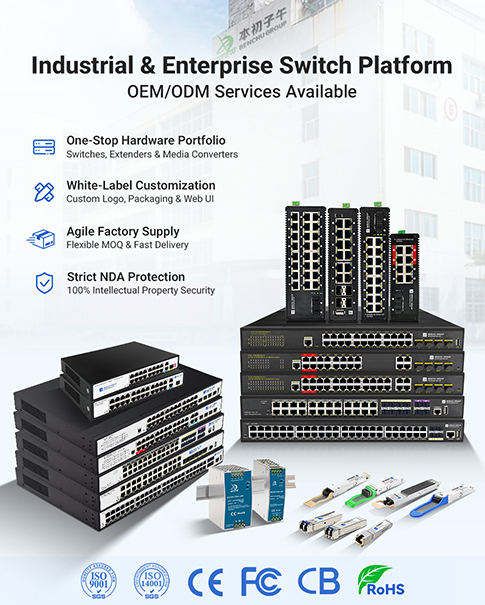
      Requesting samples from a PoE switch manufacturer is an important step in evaluating the quality and suitability of their products for your needs. Here’s a detailed process to guide you through requesting samples effectively:   1. Identify Potential Manufacturers Start by researching PoE switch manufacturers that align with your business needs, considering factors such as: Product Range: Look for manufacturers offering the type of PoE switches (e.g., PoE+, PoE++, managed or unmanaged) you require. Reputation: Prioritize manufacturers with positive customer reviews and proven industry experience. Customization Options: If needed, identify manufacturers who can offer customized configurations or OEM/ODM services.     2. Prepare Key Information Before reaching out to request samples, ensure you have the following information ready: Your Business Profile: Briefly describe your company, the industry you serve, and the purpose for testing the PoE switches. Product Specifications: Be specific about the type of PoE switch you need, including port count, PoE standard (e.g., 802.3af, 802.3at, 802.3bt), and any additional features like Layer 3 support or energy efficiency. Order Volume: While you may only be requesting a sample, providing an estimated bulk order volume can help the manufacturer understand your potential long-term needs. Shipping Details: Include your shipping address and preferred method, especially if international shipping is required.     3. Contact the Manufacturer Once you've identified the manufacturer and prepared the necessary details, it’s time to reach out. Here’s how to do so: A. Email Request --- Subject: Sample Request for PoE Switches Body: --- Introduce Your Company: Briefly mention your business and the type of PoE switches you’re looking for. --- Specify Sample Request: Clearly state that you're requesting samples for evaluation purposes. Mention the quantity you would like to receive. --- Request for Terms: Ask about sample pricing (if applicable), shipping costs, lead time, and any other terms associated with the sample request. --- Contact Details: Ensure to include your contact information for follow-up. B. Contact Form on Manufacturer’s Website --- Many PoE switch manufacturers have contact forms on their website where you can directly inquire about samples. The process is similar to emailing but requires filling out an online form. Details to Include: --- Company information --- Product specifications --- Sample quantity --- Delivery address --- Questions about costs and terms     4. Follow-Up --- If you don’t receive a response within a week or two, follow up with a polite email or phone call. Restate your interest in testing the product and inquire about the status of your sample request.     5. Sample Review and Feedback Once you receive the sample, evaluate it thoroughly based on the following: Build Quality: Check the physical durability, design, and material of the PoE switch. Power Delivery: Test the switch’s ability to supply PoE power to devices (like IP cameras, VoIP phones, etc.). Ease of Use: Assess the user interface for managed switches or ease of installation for unmanaged ones. Performance: Test the switch’s stability under load and ensure it meets your network’s performance requirements. Support: If you encounter issues, reach out to the manufacturer’s support team to assess their responsiveness and expertise.     6. Negotiate Bulk Orders After Sample Evaluation --- If the sample meets your expectations, request a formal quote for bulk purchases and discuss potential discounts, lead times, and shipping arrangements. Manufacturers may offer better pricing or terms for larger quantities once they know you're a serious buyer.     7. Consider Trial Periods --- Some manufacturers offer a trial period for a small batch of PoE switches, allowing you to test the products in a live environment before committing to larger orders. Inquire about such options if you need more assurance before proceeding.     Conclusion Requesting samples from PoE switch manufacturers is a straightforward process. It involves researching manufacturers, specifying your needs, contacting them with a detailed request, and thoroughly evaluating the samples you receive. Always consider the full cost of shipping, handling, and any potential customization options when negotiating for samples.    
    Read More

leave a message

leave a message
If you are interested in our products and want to know more details,please leave a message here,we will reply you as soon as we can.
submit

home

products

WhatsApp

Contact Us