White-Label Network Switches: The Complete Guide for Global Distributors
Jul 03, 2026
An Engineering & Procurement Analysis on Scaling Portfolio Margins Through Strategic OEM/ODM Hardware Sourcing.
Executive Summary
For global networking distributors, systems integrators, and security hardware providers, navigating the transition from selling tier-one brand equipment to establishing proprietary hardware lines is critical to preserving margins. This comprehensive guide examines the technical and commercial dynamics of white-label hardware adoption. By analyzing hardware architecture, firmware customization, and supply chain efficiency, we provide a blueprint for sourcing high-performance communication hardware that satisfies rigid industrial and enterprise requirements while optimizing total cost of ownership (TCO).
The Shift to Proprietary Hardware Portfolios
The global telecommunications and enterprise networking landscapes are undergoing a profound structural shift. Rigid, closed-ecosystem hardware models traditionally dominated by tier-one brands are increasingly giving way to open, programmable, and customizable infrastructure. For international distributors and security framework engineers, this evolution represents an unprecedented commercial opportunity. Moving away from low-margin agency distribution toward private-label deployment allows firms to capture substantial ecosystem equity, eliminate vendor lock-in, and provide tailored hardware directly aligned with specific regional compliance standards.
However, executing this transition successfully requires deep alignment between brand vision and production capabilities. This is where partnering with a specialized network switch supplier becomes foundational. Rather than allocating extensive capital expenditures to greenfield research and electronic design automation (EDA), distributors can utilize established production pipelines. By leveraging verified physical layers (PHY), robust thermal dissipation designs, and comprehensive compliance certifications (such as CE, FCC, and RoHS), organizations can accelerate their time-to-market from years to months.
Technical Fundamentals: Decoding the OEM/ODM Architecture
From an engineering perspective, a white-label switch must not simply match the data sheets of prominent industry alternatives; it must exhibit equivalent or superior MTBF (Mean Time Between Failures) and deterministic packet forwarding behavior. When evaluating options, procurement teams must analyze the hardware architecture across several critical vectors: silicon efficiency, power delivery, and environmental hardening.
Silicon and ASIC Selection
The core processing engine determines throughput, packet buffer depth, and layer-2/layer-3 feature density. Premium white-label units leverage market-leading silicon architectures (such as Broadcom, Marvell, or Realtek) to guarantee wire-speed forwarding without frame loss across all port configurations.
Power Over Ethernet (PoE) Budgets
Modern enterprise surveillance and smart-building systems demand robust power delivery mechanisms. Implementing a high-capacity PoE switch for IP surveillance network infrastructure requires robust Power Sourcing Equipment (PSE) controllers and efficient internal power supplies capable of supporting IEEE 802.3af/at (PoE+) or IEEE 802.3bt (PoE++ up to 90W) standards without thermal degradation.
Industrial-Grade Hardening
For deployments in unconditioned environments—such as transport hubs, heavy manufacturing floors, or outdoor surveillance enclosures—standard commercial switches are prone to premature failure. Sourcing a dedicated DIN-Rail PoE switch OEM design ensures the inclusion of ruggedized aluminum enclosures (IP30/IP40 rated), fanless passive cooling systems, redundant DC power inputs, and robust 6KV surge/ESD protection capable of continuous operation from -40°C to 75°C.
Comparative Matrix: Commercial vs. Hardened Hardware Paradigms
To clarify procurement parameters for global distribution portfolios, the following architectural matrix contrasts the engineering specifications of standard enterprise white-label designs against hardened, industrial-grade variants:
Technical Vector
Commercial Enterprise Switch
Hardened Industrial Switch
Thermal Architecture
Active cooling (internal fans); -10°C to 50°C (14°F to 122°F) operational envelope
Fanless passive dissipation; -40°C to +75°C extended envelope
Form Factor / Mounting
19-inch rackmount or standard desktop sheet-metal chassis
High-density corrugated aluminum chassis; DIN-Rail or Wall mount
Surge & ESD Protection
Standard differential mode: 1KV to 2KV protection
Heavy-duty industrial standard: 6KV common mode protection
Power Inputs
Single fixed internal AC power supply module
Dual redundant terminal block DC inputs (48V-57V)
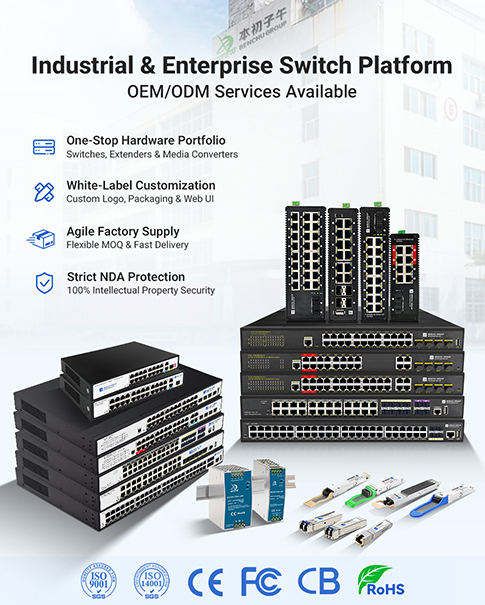
Core White-Label Portfolio Configurations
High-performance OEM/ODM platforms ready for full visual and software stack customization.
Enterprise L3 Managed
SP7500-24PGE8GFC4TF-L3M
24-Port Gigabit Managed PoE Switch with 10G Uplinks
Ports: 24× Gig RJ45 + 8× 1G SFP Combo
Uplink: 4× 1G/2.5G/10Gb SFP+ Fiber Slots
Power: 360W PoE Budget (Total 400W Power)
Protocols: L3 Static Routing, OSPF, VRRP, ERPS
View Datasheet →
High-Density Aggregation
SP7500-48PGE4TF-L3M-800W
Managed 48-Port Gigabit High-Power PoE Platform
Ports: 48× Gigabit RJ45 Full PoE+
Uplink: 4× 10G SFP+ High-Speed Optical Slots
Capacity: 760W PoE Budget / 800W Max Output
Management: WEB, CLI, SNMP, SSH Secure Suite
View Datasheet →
Ruggedized DIN-Rail
IES7211-8PGE2GF-4BT-DC
8-Port Industrial PoE++ Switch with 2 SFP Slots
PoE Capacity: 4× 90W Ultra PoE++ + 4× PoE+
Enclosure: Fanless IP40 Rugged Aluminum Case
Operating Temp: Extended -40°C to +85°C Enclosure
Protection: ±8KV DC / ±15KV Air Contact ESD
View Datasheet →
Heavy Industry PoE++
IES7521-24PGE4GC-4BT-AC
24-Port Industrial L2+ Managed High-Power Switch
Ports: 24× Gig RJ45 + 4× Gigabit Combo Ports
PoE Capacity: 4 Ports support 90W PoE++ (500W Budget)
Hardening: -30°C to 75°C Range with Non-Blocking Line-Rate
Customization: Fully Custom White-Label WebUI & CLI Stack
View Datasheet →
Maximizing Portfolio Value via Software and Firmware Customization
While raw electronic engineering determines physical endurance, firmware customization defines market positioning and brand integrity. A true white-label deployment separates software experiences from the manufacturing layer, enabling distributors to offer proprietary solutions tailored to regional demand.
When collaborating with a flexible industrial PoE switch manufacturer, global distributors gain access to full software-stack customization. This encompasses the integration of corporate visual branding onto the Web Management Interface (WebUI), customizable Command Line Interfaces (CLI), bootloaders, and customized default configuration states (such as pre-configured VLAN structures or specialized QoS rules optimized for voice or video streaming traffic). Furthermore, technical architects can request advanced network resilience protocols, such as ERPS (Ethernet Ring Protection Switching) ITU-T G.8032, ensuring self-healing network recovery times under 20ms in mission-critical environments.
Evaluating Supply Chain Security and Manufacturing Excellence
Sourcing high-volume networking products requires deep scrutiny of the manufacturing ecosystem. Selecting a production partner located in a leading global electronics R&D hub like Shenzhen, China, offers critical supply chain advantages. Proximity to primary semiconductor foundries, specialized inductive components suppliers, and advanced high-speed surface-mount technology (SMT) packaging facilities minimizes assembly lead times and insulates portfolios from localized logistics friction.
A reliable industrial ethernet switch factory must adhere to rigorous quality management system (QMS) principles. Professional suppliers utilize automated optical inspection (AOI), in-circuit testing (ICT), and multi-stage environmental stress screening (ESS)—including extended high-temperature burn-in cycles under full PoE load—to identify latent component defects prior to international shipping. For global distributors, these rigorous validation protocols ensure minimal return-merchandise authorization (RMA) overhead and safeguard brand reputation across long-term enterprise deployments.
Build Your Own Brand Portfolio with Bench Group
Stop competing on compressed reseller margins. Launch your premium line of fully certified, enterprise and industrial white-label network switches today.
Email our engineering team today at harry@benchu-group.com to request an engineering dataset, bulk wholesale pricing, or customized OEM/ODM evaluation samples.
Read More

 E-Mail Us
 Call Us
 Address


 IPv6 network supported
 English