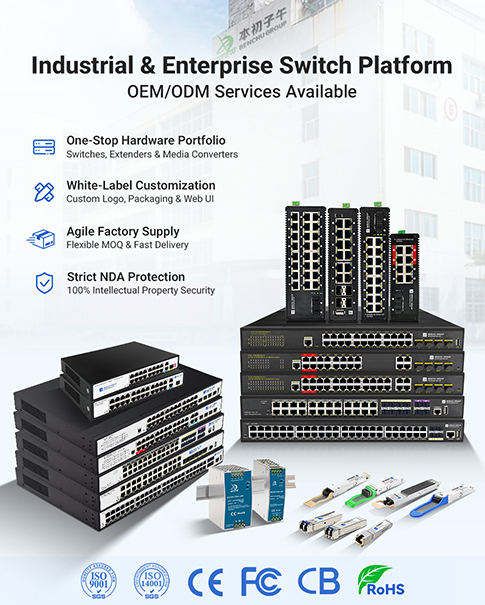
Industrial Network Switch PoE

Home

Industrial Network Switch PoE

  • What is the typical lifespan of an industrial switch?
    Aug 19, 2022
      The lifespan of an industrial PoE ethernet switch is typically much longer than that of a standard commercial switch, largely due to its rugged design and ability to withstand harsh environmental conditions. On average, an industrial switch can last anywhere between 10 to 15 years, although this can vary based on several factors such as the operating environment, the quality of the switch, and how well it is maintained. Here’s a detailed look at the factors influencing the lifespan of an industrial switch:   1. Environmental Conditions Industrial switches are designed to operate in environments that might be too harsh for regular commercial switches, but the specific conditions can still significantly impact the switch's longevity. Temperature Extremes: Industrial switches are often rated to operate in wide temperature ranges, typically from -40°C to +75°C (-40°F to 167°F). However, constant exposure to extreme temperatures can gradually reduce the switch’s lifespan. For example, switches used in outdoor environments or near industrial furnaces may face more wear and tear over time. Moisture and Humidity: In humid or wet environments, switches with higher Ingress Protection (IP) ratings (such as IP65, IP67) are used to protect against moisture ingress. Even with protection, prolonged exposure to excessive moisture can shorten the lifespan of a switch, especially if seals or enclosures degrade over time. Vibration and Shock: Switches installed in environments with significant vibration, such as in heavy machinery or transport systems (e.g., trains, vehicles), are often designed with shock resistance. However, continuous mechanical stress can still affect the internal components and lead to a shorter lifespan. Electromagnetic Interference (EMI): Industrial switches are often deployed in environments with significant EMI (such as power plants or heavy industrial settings). While they are built to handle EMI better than commercial switches, prolonged exposure can still degrade their components and connections, impacting longevity. Lifespan Impact: Industrial switches deployed in extreme or harsh conditions may last on the shorter end of the spectrum (around 10 years), especially if not properly maintained.     2. Switch Quality and Design The quality of the materials and the overall design of the switch play a crucial role in determining its lifespan. High-Quality Components: Industrial switches are typically constructed with high-grade materials that are resistant to corrosion, moisture, and heat. Premium switches use military-grade components, which are designed for durability and extended service life. Thermal Management: Some high-end industrial switches have built-in thermal management systems or enhanced airflow designs to prevent overheating. Effective heat dissipation can significantly prolong the life of the switch, especially in environments where cooling is a concern. Power Supply Design: Industrial switches often include redundant power inputs or industrial-grade power supplies that ensure stable and uninterrupted power. These power supplies are more robust and resistant to power fluctuations, increasing the overall durability of the switch. Lifespan Impact: Higher-quality industrial switches with superior materials and design can easily surpass 15 years if they are deployed in relatively stable environments.     3. Usage and Workload The actual workload on the switch, including how much traffic it handles and the intensity of its usage, can also affect its lifespan. High-Traffic Environments: If the switch is constantly managing high volumes of data traffic, such as in a data-heavy industrial application (e.g., real-time video monitoring or automation systems), it may experience more wear and tear on its internal components. Overutilization: Running a switch close to its maximum capacity for extended periods can lead to overheating or accelerated degradation of components, especially if the switch is not adequately cooled. Intermittent Usage: On the other hand, switches that are used intermittently or that operate at less than full capacity typically last longer because they experience less physical stress. Lifespan Impact: Switches operating under heavy load or near their capacity may have a shorter lifespan compared to those with lower, intermittent traffic.     4. Maintenance Practices Regular maintenance plays a crucial role in extending the life of an industrial switch. Although industrial switches are often designed for minimal maintenance, proper care is still important for long-term reliability. Firmware Updates: Manufacturers often release firmware updates to improve performance, patch security vulnerabilities, or enhance the reliability of the switch. Regularly updating the firmware can help ensure the switch remains efficient and secure, prolonging its lifespan. Physical Inspections: Periodically inspecting switches for physical wear, dust accumulation, and proper sealing can prevent issues like overheating or moisture ingress. Cleaning vents and ensuring proper airflow can prevent internal components from degrading prematurely. Port Health: Frequently used ports can become worn over time. Monitoring for loose connections or signs of corrosion can help catch issues early before they cause damage or downtime. Lifespan Impact: Regular maintenance and firmware updates can extend the life of an industrial switch, ensuring it operates efficiently for its full potential lifespan.     5. Redundancy and Failure Protection Many industrial switches are designed with redundancy and failure protection features, which can increase their lifespan and the overall reliability of the network. Redundant Power Supplies: Industrial switches often have dual power inputs. If one power source fails, the switch can automatically switch to the backup power supply, preventing downtime and reducing wear on the main power supply. Network Redundancy: Switches deployed in high-availability networks often use redundant ring topologies or Rapid Spanning Tree Protocol (RSTP), which help minimize stress on any single component by providing alternate paths for data in case of failure. This can reduce the overall load on individual switches and extend their lifespan. Lifespan Impact: The use of redundant systems can protect switches from early failure and allow them to operate more efficiently over time.     6. Technology and Obsolescence While industrial network switch PoE are built to last physically, technological obsolescence can also influence their effective lifespan. Upgrading to New Technologies: Industrial networks evolve, and newer standards (e.g., faster Ethernet speeds, advanced security protocols) may require you to replace older switches even if they are still functioning. For example, if your current switch only supports Fast Ethernet (100 Mbps), you may eventually need to upgrade to Gigabit Ethernet or 10-Gigabit Ethernet as network demands increase. Vendor Support: Most manufacturers provide support and replacement parts for industrial switches for a specific period. If a switch becomes obsolete and is no longer supported, its effective lifespan may end prematurely if spare parts or firmware updates are no longer available. Lifespan Impact: Technological advancements and lack of vendor support may shorten the usable life of a switch, even if it is still physically operational.     Conclusion: Key Factors Affecting Lifespan Factor Typical Lifespan Impact Environment Harsh conditions (extreme temperatures, moisture, EMI) can reduce lifespan. Stable environments allow switches to reach their full 10-15 year potential. Switch Quality Higher-quality materials and design lead to longer lifespans, often exceeding 15 years in stable conditions. Usage and Workload Heavy workloads and high traffic reduce lifespan, while lighter or intermittent usage extends it. Maintenance Regular firmware updates, inspections, and cleaning significantly extend the life of the switch. Redundancy Redundant power supplies and network paths help reduce stress and extend the switch's life. Technology Obsolescence Technological advances may shorten the effective lifespan of a switch even before it physically fails.   In summary, a well-maintained industrial switch deployed in a stable environment with moderate usage can last up to 15 years or more. However, harsh conditions, heavy workloads, and lack of maintenance can reduce this lifespan. Technological advancements and the switch's compatibility with modern standards may also determine when you ultimately replace the switch, even if it remains operational.    
    Read More
  • Are industrial switches suitable for outdoor use?
    Sep 12, 2022
      Yes, industrial network switch PoE are highly suitable for outdoor use, particularly because they are designed to withstand extreme environmental conditions that regular commercial switches cannot handle. However, not all industrial switches are automatically suited for outdoor use—there are specific characteristics and features to consider to ensure the switch can operate reliably in outdoor environments. Below is a detailed description of why and how industrial switches are suitable for outdoor applications, along with the features and considerations that make them ideal for such use.   1. Rugged and Durable Design Industrial switches intended for outdoor use are built with ruggedized enclosures and materials that protect them from various external factors such as temperature fluctuations, moisture, dust, and physical impact. Key aspects of their design include: Ingress Protection (IP Rating): Most outdoor-rated industrial switches come with a high IP rating, usually IP65 or above, which ensures that the switch is resistant to dust, water, and even direct jets of water. Higher IP ratings, such as IP67 or IP68, can protect switches from temporary or continuous submersion in water, making them ideal for applications like remote weather stations or surveillance in flood-prone areas. Durable Materials: Industrial switches for outdoor use are often constructed from corrosion-resistant materials, such as stainless steel or heavy-duty aluminum. This ensures they are protected from the elements, such as rain, humidity, salt spray in coastal areas, and even chemical exposure in industrial plants. Shock and Vibration Resistance: Outdoor industrial environments, such as transportation systems (railways, highways) or construction sites, may experience significant vibrations or shocks. Outdoor-rated industrial switches are often built with shockproof and vibration-resistant casings to ensure stable operation even in such conditions.     2. Temperature and Climate Resistance Outdoor environments can experience extreme temperature variations, from freezing cold to scorching heat. Industrial switches designed for outdoor use are built to withstand these conditions: Wide Temperature Range: Most industrial switches intended for outdoor environments operate over a wide temperature range, typically between -40°C to +75°C (-40°F to +167°F). This makes them suitable for use in environments that experience extreme cold (such as mountaintop installations) or intense heat (such as desert or rooftop installations). Thermal Management: Outdoor switches are designed to dissipate heat efficiently to prevent overheating in hot climates. Some switches include fanless designs that rely on passive cooling, which reduces the risk of mechanical failure and ensures long-term reliability in dusty or dirty environments where fans might get clogged.     3. Weatherproofing and Environmental Protections Industrial switches for outdoor use are protected against various environmental hazards commonly found outside: UV-Resistant Housing: Sun exposure can degrade materials over time, so outdoor-rated industrial switches often come with UV-resistant enclosures to prevent damage from long-term exposure to sunlight. Humidity and Condensation Resistance: Outdoor switches may be exposed to high humidity, dew, or condensation, especially in coastal or tropical environments. These switches are designed with protective sealing mechanisms to prevent moisture from entering the enclosure and damaging internal components. Salt and Corrosion Resistance: In coastal areas or near industrial plants where the air contains corrosive chemicals or salt particles, industrial switches with corrosion-resistant coatings (such as stainless steel or specially treated plastics) are used to prevent long-term damage.     4. Protection from Power Fluctuations Outdoor environments, especially in remote areas, can experience power fluctuations, including surges, brownouts, or complete power loss. Industrial switches designed for outdoor use include several protections against these issues: Surge Protection: Outdoor industrial switches often come with built-in surge protection to handle voltage spikes caused by lightning strikes or fluctuations in the power supply, ensuring that the switch remains operational without damage. Redundant Power Inputs: Some outdoor industrial switches support dual power inputs, allowing for a backup power source. This feature is particularly valuable in critical applications where uptime is essential, such as traffic management systems or outdoor surveillance networks. Power over Ethernet (PoE): Many outdoor-rated industrial switches support Power over Ethernet (PoE), which allows devices like IP cameras or wireless access points to receive both data and power through the same cable. This is particularly useful in outdoor installations where it’s difficult or costly to run separate power lines.     5. Connectivity and Network Reliability Outdoor industrial switches are often deployed in applications that require high reliability and fast recovery from network issues, such as smart city infrastructure, transportation systems, or outdoor surveillance. Features that enhance their network performance include: Redundancy Protocols: Outdoor industrial switches support network redundancy protocols, such as Rapid Spanning Tree Protocol (RSTP) or Ethernet Ring Protection Switching (ERPS), which ensure quick recovery in case of a link failure. In a typical ring topology, the switch can reroute traffic within milliseconds, preventing downtime in critical applications. Fiber Optic Support: Many outdoor applications, such as long-distance communications or environments with significant electromagnetic interference (EMI), require fiber optic connections. Industrial switches often come equipped with fiber optic ports to ensure long-distance, high-speed data transmission with minimal signal loss.     6. Mounting and Installation Considerations Outdoor industrial switches are designed for flexible installation in a variety of environments, from poles and walls to rugged outdoor cabinets. DIN-Rail or Wall Mounting: Many outdoor switches are designed for DIN-rail or wall-mounting, allowing them to be easily installed in industrial control cabinets or on outdoor poles. Outdoor Enclosures: In cases where additional protection is needed, industrial switches can be installed in weatherproof enclosures with additional cooling, heating, or ventilation. These enclosures are often NEMA-rated (e.g., NEMA 4X) to protect against dust, moisture, and even explosive atmospheres in hazardous locations.     7. Certifications for Outdoor Use Outdoor-rated industrial switches often come with certifications that verify their suitability for harsh environments, especially in industries where compliance is essential: IP Ratings (Ingress Protection): As mentioned earlier, an IP rating (e.g., IP65, IP67) certifies that the switch is protected from dust, water, and other environmental hazards. NEMA Ratings: These ratings (e.g., NEMA 4, NEMA 4X) specify the level of protection against environmental conditions, such as corrosion or exposure to weather elements. ATEX/UL Class 1 Division 2: In hazardous outdoor environments, such as oil and gas facilities or chemical processing plants, outdoor industrial switches with ATEX or UL Class 1 Division 2 certification can be deployed safely. IEC 61850 Compliance: For outdoor applications in energy systems (such as substations), switches may comply with IEC 61850, ensuring reliable operation in high-voltage and high-EMI environments.     Common Outdoor Applications for Industrial Switches Industrial switches are used in a variety of outdoor applications that require rugged, reliable network connectivity, including: 1.Smart City Infrastructure: Supporting street lighting, traffic management, and public safety systems in cities. 2.Transportation Systems: Managing networks for railways, highways, and airports, where vibration, weather, and temperature extremes are common. 3.Outdoor Surveillance: Providing connectivity for IP cameras, monitoring systems, and access points in large public spaces or remote areas. 4.Utilities and Energy: Facilitating communication for wind farms, solar plants, power grids, and water treatment facilities. 5.Remote Monitoring and Control: For applications like oil pipelines, remote weather stations, or mining sites, where long distances and harsh conditions are common.     Conclusion Industrial PoE ethernet switch are not only suitable for outdoor use but are often the ideal solution for outdoor environments that require durability, reliability, and resistance to extreme conditions. With features like rugged enclosures, wide temperature tolerance, protection against moisture and dust, surge protection, and redundancy protocols, these switches are designed to ensure stable and continuous network operations in even the most demanding outdoor environments. However, it’s essential to select the right switch with the appropriate IP rating, temperature range, mounting options, and certifications for your specific application to ensure optimal performance and longevity.    
    Read More
  • Can I use an industrial switch in a factory setting?
    Oct 11, 2022
      Yes, industrial PoE ethernet switch are specifically designed for use in harsh environments like factories, where conditions such as extreme temperatures, dust, moisture, electromagnetic interference, and vibration are common. Their robust construction and enhanced features make them ideal for ensuring reliable network performance in demanding industrial applications. Here’s a detailed explanation of why industrial switches are suitable for a factory setting:   1. Durability and Rugged Design Industrial switches are built with durable materials and rugged designs to withstand the challenging conditions found in factories. Unlike commercial-grade switches, which are typically installed in climate-controlled offices or data centers, industrial switches are engineered for environments where they might be exposed to: --- High levels of dust and debris from machinery and production processes --- Moisture or liquid exposure from spills, humidity, or cleaning processes --- High levels of vibration from nearby heavy equipment and motors --- Extreme temperatures ranging from sub-zero to high heat, depending on the factory's location and processes Many industrial switches have Ingress Protection (IP) ratings, such as IP30 or higher, which protect them from dust and water ingress, ensuring long-term reliability in such environments.     2. Wide Operating Temperature Range Factories often experience extreme temperature fluctuations, especially in areas with heavy machinery or near furnaces. Industrial switches are designed to operate reliably in a much wider temperature range compared to commercial switches. While typical office switches might be rated for temperatures between 0°C to 40°C (32°F to 104°F), industrial switches are often rated for extreme conditions: --- Standard industrial switches: Operating temperature range of -10°C to 70°C (14°F to 158°F) --- Hardened industrial switches: Can operate in even more extreme conditions, with ranges such as -40°C to 85°C (-40°F to 185°F) This wide temperature tolerance makes industrial switches ideal for both indoor and outdoor areas of a factory, including in environments with high heat, cold storage areas, or near industrial ovens.     3. Shock and Vibration Resistance --- In many factory settings, heavy machinery can generate vibrations that would compromise the performance of commercial-grade network devices. Industrial switches are engineered with shock and vibration resistance to ensure continuous operation even in these harsh conditions. They are often tested to withstand the mechanical stress caused by vibration from equipment such as conveyors, presses, and turbines. --- Some models are even DIN-rail or panel-mountable, allowing secure installation on factory walls, cabinets, or within enclosures, further stabilizing the switch in areas where there is frequent movement.     4. Electromagnetic Interference (EMI) Protection Factories are filled with equipment like motors, welders, and generators that produce high levels of electromagnetic interference (EMI). This interference can disrupt data transmission and cause network downtime if devices aren’t properly shielded. Industrial switches are designed to handle high levels of EMI by incorporating: EMI-shielded enclosures: To block external interference from entering the switch EMC compliance: Ensuring the switch meets electromagnetic compatibility standards for use in industrial environments These features ensure stable data transmission even when operating in proximity to equipment that generates strong electromagnetic fields, making industrial switches perfect for factories with heavy electrical machinery.     5. Redundant Power Inputs --- Power stability is critical in factory settings, where network disruptions could lead to costly production delays. Industrial switches typically have dual redundant power inputs, which allow them to be connected to two separate power sources. If one power source fails due to fluctuations, outages, or maintenance, the switch will automatically switch to the backup power source, ensuring uninterrupted operation. --- This feature is particularly important in factory environments where power outages or electrical fluctuations can occur, as it provides continuous uptime for critical industrial systems.     6. High Network Reliability with Redundancy Protocols Industrial network switch PoE often support network redundancy protocols, ensuring high availability of the network even in the event of a failure in one part of the system. Common redundancy protocols include: Rapid Spanning Tree Protocol (RSTP): Allows fast recovery from a network failure by rerouting traffic within milliseconds if a link or switch goes down. Ethernet Ring Protection Switching (ERPS): Ensures minimal downtime by using a ring topology to allow for rapid recovery in case of a network segment failure. This is especially useful in factory settings where continuous communication between different areas of the plant floor, such as between robots, controllers, and production systems, is essential for smooth operations.     7. Support for Real-Time Data Transmission Factories often run Industrial Internet of Things (IIoT) applications, where real-time data transmission is critical. Industrial switches are designed with features that ensure low-latency, high-speed data transmission, and deterministic behavior. This is essential for applications such as: Process automation: Where precise timing and immediate responses are required for machinery, production lines, and control systems to operate efficiently. Robotics: For coordinating movements and ensuring synchronization between various robots and control systems in an assembly line. Condition monitoring: Where sensors track the performance and health of equipment in real-time, helping predict failures and reduce downtime. To meet these needs, industrial switches are equipped with features such as Quality of Service (QoS), VLANs (Virtual Local Area Networks), and Layer 2/Layer 3 support to prioritize traffic and ensure efficient handling of critical data streams.     8. Power over Ethernet (PoE) Capability In a factory setting, many devices such as IP cameras, wireless access points, and sensors are deployed in areas where running separate power cables is impractical. Industrial switches with PoE (Power over Ethernet) capability allow these devices to receive both data and power over a single Ethernet cable, simplifying installation and reducing wiring costs. This is particularly useful for: --- IP surveillance systems for monitoring production lines or securing facilities --- Wireless networks for connecting devices across large factory floors --- IIoT sensors and controllers in remote or hard-to-access locations     9. Centralized Network Management Modern factories require centralized control of all connected devices to ensure efficient operation, including machines, controllers, and sensors. Many industrial switches feature SNMP (Simple Network Management Protocol) and web-based management interfaces, which allow network administrators to monitor and manage the factory’s entire network from a central location. These management tools provide: Real-time monitoring: Of network health, traffic, and device status Fault detection and troubleshooting: With automatic alerts in case of any failures Remote configuration: Allowing quick changes to the network setup without having to physically access each switch     10. Long Lifespan and Reliability Industrial switches are built to last, with high-quality components that provide greater reliability and a longer operational lifespan than typical commercial switches. They are often designed with fanless cooling, which eliminates moving parts that can fail, making them ideal for dusty and debris-filled environments where mechanical fans might get clogged. Some industrial switches are rated for MTBF (Mean Time Between Failures) values of over 100,000 hours, ensuring dependable performance even in challenging conditions.     Conclusion Industrial switches are highly suited for factory settings due to their rugged design, resistance to environmental factors, and ability to operate in harsh conditions. They provide high network reliability, redundant power, real-time data handling, and support PoE devices, making them ideal for critical applications in industrial automation, robotics, process control, and IIoT. Factories benefit from using industrial switches because they deliver consistent, reliable performance while withstanding the environmental challenges found on the factory floor.    
    Read More
  • What features should I look for in an industrial switch?
    Oct 13, 2022
      When selecting an industrial network switch PoE for your application, it's important to focus on features that ensure durability, reliability, and performance in harsh environments. Industrial switches differ from commercial switches due to their ability to withstand environmental challenges, support industrial protocols, and offer advanced network management capabilities. Below is a detailed description of key features to look for in an industrial switch:   1. Durability and Rugged Construction Industrial switches must be designed to withstand harsh physical and environmental conditions, so look for: Rugged Enclosure: The switch should have a robust metal or reinforced plastic housing that can withstand physical impact, dust, and debris. Ingress Protection (IP) Rating: Choose a switch with a high IP rating, such as IP30 or higher, to ensure protection from dust and water ingress. For outdoor or wet environments, consider a switch with an IP67 rating for waterproofing. Wide Operating Temperature Range: The switch should be rated for a wide range of temperatures, such as -40°C to 85°C (-40°F to 185°F), depending on your environment (e.g., extreme heat in factories or cold in outdoor installations). Vibration and Shock Resistance: Industrial switches should comply with standards such as IEC 60068-2 to ensure they can handle vibrations and shocks typical in industrial environments with heavy machinery.     2. Redundant Power Inputs Redundant power inputs provide reliability by allowing the switch to operate even if one power source fails. Look for: Dual Power Inputs: These enable the switch to connect to two separate power sources, ensuring continuous operation if one source fails. Support for DC Power: Since many industrial sites use DC power, it's important that the switch supports wide-range DC input (e.g., 12V-48V DC) to be compatible with various power supplies. Power Failure Alarm: Some switches have an alarm relay to notify administrators when power is lost, enabling quick troubleshooting and ensuring minimal downtime.     3. Advanced Network Redundancy Industrial environments often require high network availability, so redundancy features are crucial. Look for: Redundancy Protocols: Choose switches that support protocols like Rapid Spanning Tree Protocol (RSTP) or Multiple Spanning Tree Protocol (MSTP) to create a redundant network that automatically reroutes traffic in case of a failure. Ring Redundancy: Consider switches with Ethernet Ring Protection Switching (ERPS) or Media Redundancy Protocol (MRP), which provide ultra-fast network recovery times (typically less than 50 milliseconds) in case of link failure. Link Aggregation: This feature allows multiple Ethernet links to be combined to increase bandwidth and provide redundancy, improving overall network reliability.     4. PoE (Power over Ethernet) Support If you need to power devices like IP cameras, wireless access points, or sensors, PoE capability is essential. Look for: PoE/PoE+ Ports: Make sure the switch supports PoE (IEEE 802.3af) and PoE+ (IEEE 802.3at) to provide sufficient power for low- and high-power devices, with PoE+ delivering up to 30W per port. PoE Budget: Check the switch's total PoE power budget, which is the maximum amount of power it can deliver across all PoE ports. Ensure the power budget is sufficient to power all connected devices. PoE Management: Some switches allow administrators to control and monitor the PoE power delivery, prioritize specific devices, or remotely restart devices.     5. High Port Density and Speed Depending on your network needs, you’ll need the right number and type of ports: Port Count: Select a switch with enough Fast Ethernet (100 Mbps) or Gigabit Ethernet (1000 Mbps) ports to support all connected devices. Fiber Ports: In large industrial networks, fiber optic connections might be needed to cover long distances. Choose switches with SFP (Small Form-factor Pluggable) slots to support fiber optic modules. Speed: For high-bandwidth applications such as video surveillance or large data transfers, opt for Gigabit Ethernet or even 10G ports if necessary.     6. VLAN and Network Segmentation Virtual LAN (VLAN) support is essential for segmenting and securing network traffic, especially in complex industrial environments. Look for: VLAN Support: Ensure the switch supports IEEE 802.1Q VLAN tagging, which allows traffic to be logically separated into different segments, improving security and reducing broadcast traffic. QoS (Quality of Service): For prioritizing critical traffic such as control signals or real-time video, the switch should support QoS, allowing you to allocate bandwidth and prioritize important traffic.     7. Layer 2 and Layer 3 Switching Depending on your network's complexity, you may need Layer 2 (Data Link) or Layer 3 (Network) functionality: Layer 2 Switches: These switches provide basic switching functions, such as MAC address learning and forwarding. They are suitable for simple factory networks. Layer 3 Switches: These include routing capabilities, enabling communication between different IP subnets. Choose a Layer 3 switch for more complex networks where routing between different network segments is necessary.     8. SNMP and Network Management For easy monitoring and configuration, the switch should have advanced management features. Look for: SNMP (Simple Network Management Protocol): This allows remote monitoring of the switch’s performance, health, and traffic via network management software. SNMP v3 adds encryption for secure management. Web-based Management Interface: A user-friendly graphical interface makes it easy to configure, monitor, and troubleshoot the switch remotely. Command Line Interface (CLI): For more advanced users, switches with CLI provide detailed control over network configurations.     9. Cybersecurity Features In industrial environments, securing the network is crucial. Look for switches with built-in security features, such as: Access Control Lists (ACLs): These allow administrators to filter and control traffic based on IP addresses or protocols, helping prevent unauthorized access. Port Security: Ensures only authorized devices can connect to specific ports, preventing rogue devices from accessing the network. DHCP Snooping: Prevents unauthorized DHCP servers from assigning IP addresses, protecting against man-in-the-middle attacks. IP Source Guard: Ensures that only traffic from authorized IP addresses is allowed on the network, enhancing security.     10. Industrial Protocol Support If your factory environment uses industrial automation systems, the switch should support specific industrial protocols. Look for: Modbus TCP, PROFINET, or EtherNet/IP: These are common industrial protocols used to communicate with Programmable Logic Controllers (PLCs) and Human-Machine Interfaces (HMIs) in automation systems. Precision Time Protocol (PTP): For time-sensitive applications such as robotics or motion control, switches that support IEEE 1588 PTP can synchronize devices with sub-microsecond precision.     11. Fanless Design and Heat Management Industrial switches are often placed in areas where dust or debris could clog fans and lead to failure. A fanless design is ideal for these environments, as it reduces moving parts and improves reliability. Additionally, look for: Effective Heat Dissipation: The switch should have a design that allows for passive heat dissipation, such as a heat sink or vented enclosure, ensuring stable operation even in high-temperature environments.     12. Compact and Flexible Mounting Options The switch’s size and mounting options should match the physical space in your environment. Look for: DIN-Rail Mounting: Common in industrial settings, DIN-rail mounting allows for quick and easy installation in control panels. Panel or Rack Mounting: Depending on your setup, you may need switches that can be panel-mounted or installed in standard 19-inch racks. Compact Size: In space-constrained environments, compact switches save space and fit easily into control cabinets or equipment racks.     Conclusion Choosing the right industrial PoE ethernet switch involves understanding the environmental conditions, network requirements, and devices that will connect to the switch. Durability, redundancy, PoE support, and VLAN segmentation are key features that ensure reliable operation in challenging factory or industrial settings. Advanced features like SNMP management, cybersecurity, and industrial protocol support make the switch more adaptable to complex industrial networks. By selecting a switch with the appropriate specifications, you can ensure reliable, high-performance networking that meets the demands of your industrial application.    
    Read More
  • How do I install an industrial-grade switch?
    Oct 15, 2022
      Installing an industrial-grade switch requires attention to detail and careful planning, as it often involves harsh environments and the need for reliable, long-term operation. Below is a step-by-step guide on how to install an industrial PoE ethernet switch, covering the entire process from preparation to final testing:   1. Preparation and Planning Before you begin installation, make sure to thoroughly prepare by considering the following: a. Determine Network Requirements --- Port Requirements: Identify how many devices will connect to the switch and what type of ports (Ethernet, fiber optic, PoE) are needed. --- Power Requirements: Verify the switch’s power requirements and ensure you have the proper power sources available. Some din rail PoE Switch support both AC and DC power, while others might only support DC. --- Environmental Conditions: Check the operating temperature range, ingress protection (IP) rating, and vibration resistance of the switch. Ensure it can handle the environmental conditions of your installation site, such as extreme heat, cold, dust, or moisture. --- Redundancy: Determine if your network needs redundancy features, such as dual power inputs or ring topology for network resilience. b. Gather Necessary Tools and Equipment --- Screwdrivers, wrenches, and other basic hand tools --- DIN rail or rack mounting kit (depending on how you plan to install the switch) --- Ethernet cables, fiber optic cables, or PoE cables (as required) --- Power supply (if not already present) --- Labeling tools (to label cables and ports) --- Cable management supplies (cable ties, trays, etc.) c. Site Inspection Conduct a physical inspection of the installation site: --- Space Availability: Ensure there's enough room for the switch, including proper airflow if it has venting or heat dissipation requirements. --- Proximity to Devices: The switch should be placed close to the devices it will serve, especially in cases where PoE (Power over Ethernet) is used to power devices like IP cameras or wireless access points. --- EMI Considerations: Avoid placing the switch near equipment that generates strong electromagnetic interference (EMI), such as motors or transformers, unless the switch has strong EMI shielding.     2. Mounting the Switch The switch needs to be securely mounted in the industrial environment. There are typically two ways to mount an industrial switch: a. DIN-Rail Mounting DIN-rail mounting is common in industrial environments because it’s compact and easy to install in control cabinets. --- Install the DIN-Rail: Securely attach the DIN rail to the mounting surface (e.g., a control cabinet or electrical panel) using screws or brackets. --- Snap the Switch onto the DIN-Rail: Align the switch's backplate with the DIN rail and press the switch firmly until it snaps into place. Ensure the switch is securely fastened. --- Secure the Cables: After mounting, route the cables to the switch’s ports, ensuring they are neatly managed and secured to prevent strain. b. Rack or Panel Mounting For larger industrial setups or where multiple switches are needed, you may use rack or panel mounting. --- Install the Rack Mounting Kit: Attach the rack mount brackets to the switch using the screws provided. --- Mount the Switch in the Rack: Slide the switch into the rack and secure it using screws or bolts at the front panel. --- Ensure Proper Airflow: Leave sufficient space around the switch for proper ventilation, especially if the switch relies on passive cooling.     3. Connecting Power Industrial-grade switches typically have redundant power options (e.g., dual DC power inputs or AC/DC options). To connect power: Ensure Power is Off: Before making any connections, ensure that power is turned off at the source to avoid electrical hazards. Connect the Power Cables: --- For DC Power: Connect the positive (+) and negative (-) leads of the DC power supply to the switch’s power input terminals. Some switches have screw terminals, so use a screwdriver to secure the wires. --- For AC Power: If the switch supports AC power, connect the AC power cable to the designated power input and secure the ground wire to prevent electrical shock. --- Redundant Power: If your switch has dual power inputs, connect the backup power source to the second input to ensure uninterrupted operation in case of a primary power failure. --- Turn on the Power: After all power connections are securely in place, turn on the power. Ensure that the switch powers up and that the status LEDs indicate normal operation.     4. Connecting Network Cables Once power is established, the next step is to connect the switch to the network and devices: a. Ethernet Cable Connections --- Connect the Uplink Port: This port typically connects the industrial switch to the main network (e.g., router or backbone switch). Use a CAT5e or CAT6 Ethernet cable for standard connections, or CAT6a for high-speed connections. --- Connect Devices: Plug the Ethernet cables from your devices (e.g., computers, controllers, sensors, or cameras) into the appropriate Ethernet ports on the switch. --- Check Link Lights: Verify that the link/activity LEDs on the switch show connectivity for each connected device. These lights usually blink to indicate network traffic. b. Fiber Optic Connections (If Applicable) --- If your switch supports fiber optic connections, plug in SFP (Small Form-factor Pluggable) transceivers into the SFP slots. --- Connect fiber optic cables to the transceivers, ensuring that you match the correct cable type (e.g., single-mode or multi-mode) and connector (e.g., LC, SC). --- Secure the fiber cables to avoid bending or damage. c. PoE Devices --- If you are using PoE to power devices like IP cameras or wireless access points, ensure the devices are connected to the PoE-enabled ports on the switch. --- The switch will provide power through the Ethernet cable, eliminating the need for separate power supplies for those devices.     5. Network Configuration After connecting all devices, you need to configure the switch to match your network requirements. For managed industrial switches, this involves: a. Accessing the Switch’s Management Interface --- Use a web browser, SSH, or telnet to access the switch's management interface. The switch’s IP address will be provided in the user manual or printed on the device itself. --- For new switches, you may need to configure an initial IP address by connecting via console cable to the switch’s serial port. b. Configuring Basic Settings --- IP Address: Assign the switch a static IP address that matches your network’s IP scheme. --- VLANs: Set up VLANs (Virtual Local Area Networks) to segment network traffic and enhance security, especially in complex industrial environments. --- QoS (Quality of Service): Configure QoS to prioritize critical network traffic, such as real-time data for machine control or video streams from security cameras. c. Enable Redundancy and Failover --- If your switch supports network redundancy protocols like Rapid Spanning Tree Protocol (RSTP) or Ethernet Ring Protection Switching (ERPS), enable them to ensure failover capabilities in case of link failure. --- For setups using multiple switches in a ring topology, configure ring redundancy protocols to allow fast network recovery in the event of a failure.     6. Testing and Verification After installation and configuration, thoroughly test the switch to ensure everything is functioning as expected. a. Check Device Connectivity --- Verify that all connected devices can communicate with each other and with the rest of the network. Use ping tests or network monitoring tools to ensure connectivity. --- Confirm that PoE devices are receiving power and operating correctly. b. Monitor Power and Redundancy --- If the switch has dual power inputs, test the redundancy by disconnecting the primary power source and checking if the switch continues to operate on the backup power. --- Ensure all redundancy protocols (if configured) are functioning by simulating link failures and checking the switch’s recovery time. c. Monitor Switch Performance --- Use the switch’s management interface to monitor traffic flow, port status, and error logs. Look for any warnings or errors that may indicate misconfigurations or hardware issues. --- Set up SNMP (if supported) for ongoing monitoring and alerts.     7. Labeling and Documentation Once the switch is installed and tested, it's important to document the setup for future reference: --- Label Ports and Cables: Clearly label all network cables and switch ports to make future maintenance or troubleshooting easier. --- Document Configuration Settings: Keep a record of the switch’s IP address, VLAN settings, redundancy configurations, and other network settings. This documentation will be useful for future maintenance or network changes.     Conclusion Installing an industrial network switch PoE requires careful planning and attention to environmental, power, and network requirements. By following the steps above—ensuring proper mounting, power redundancy, network configuration, and testing—you can ensure reliable operation of your industrial switch in even the most demanding environments. Proper labeling and documentation will also help streamline future troubleshooting and network expansion efforts.    
    Read More
  • What protocols do industrial switches support?
    Oct 17, 2022
      Industrial PoE ethernet switch support a wide range of protocols designed to ensure robust, reliable, and efficient communication in industrial environments. These protocols help with redundancy, network management, automation, and real-time data exchange, which are critical in industrial settings like manufacturing, energy, transportation, and utilities. Below is a detailed description of the key protocols supported by industrial switches:   1. Redundancy and Failover Protocols In industrial environments, high availability and minimal downtime are essential. Redundancy protocols help maintain network connectivity even when there’s a failure in one part of the network. Some key redundancy protocols include: a. Spanning Tree Protocol (STP) IEEE 802.1D: STP prevents loops in Ethernet networks by creating a loop-free tree structure. In case of a link failure, STP reconfigures the network by activating backup paths. Rapid Spanning Tree Protocol (RSTP): IEEE 802.1w is an improved version of STP that offers faster convergence times (typically in a few seconds) after a link failure. Multiple Spanning Tree Protocol (MSTP): IEEE 802.1s allows multiple spanning trees to be active simultaneously, making it more efficient for VLAN environments. b. Ethernet Ring Protection Switching (ERPS) ITU-T G.8032: ERPS is a ring-based redundancy protocol used in industrial networks. It provides fast recovery times, typically less than 50 milliseconds, by rerouting traffic around a failure point in ring topologies. c. Media Redundancy Protocol (MRP) IEC 62439-2: MRP is designed for industrial Ethernet networks that use a ring topology. It provides redundancy with very fast network recovery (less than 10 milliseconds), commonly used in automation networks with PROFINET.     2. Automation and Industrial Control Protocols Industrial switches support various protocols that enable communication between automation devices, such as Programmable Logic Controllers (PLCs), Human-Machine Interfaces (HMIs), and Supervisory Control and Data Acquisition (SCADA) systems. These protocols ensure timely and reliable communication in automation systems: a. Modbus TCP --- Modbus TCP/IP is an Ethernet-based protocol widely used in industrial automation systems. It allows devices like sensors, actuators, and controllers to communicate over an IP-based network. Industrial switches enable seamless communication between Modbus TCP devices. b. EtherNet/IP --- CIP (Common Industrial Protocol) over Ethernet is known as EtherNet/IP. It is commonly used in factory automation and process control. Industrial switches that support EtherNet/IP are ideal for networks where real-time data exchange between PLCs and other devices is critical. c. PROFINET --- PROFINET is an Ethernet-based protocol used in industrial automation for real-time control and automation. It provides fast and deterministic communication between field devices (sensors, actuators) and control systems (PLCs). Industrial grade switch supporting PROFINET are often used in factory automation environments. d. BACnet/IP --- BACnet/IP is a communication protocol for Building Automation and Control Networks (BACnet), used in applications such as HVAC, lighting control, and security systems. Industrial network switch PoE can enable seamless communication between BACnet devices over Ethernet networks. e. Precision Time Protocol (PTP) --- IEEE 1588 (PTP) is a protocol that allows precise time synchronization between devices in a network. This is essential in applications like motion control, robotics, and energy management, where timing accuracy is critical. Industrial switches that support PTP ensure sub-microsecond synchronization across devices.     3. Quality of Service (QoS) and Traffic Prioritization In industrial networks, certain types of data, such as real-time control signals, must be prioritized over less critical data. Industrial switches use Quality of Service (QoS) protocols to manage and prioritize network traffic effectively: IEEE 802.1p: This standard defines traffic prioritization, allowing switches to prioritize specific types of network traffic, such as control signals or video streams, over less critical data. --- DiffServ (Differentiated Services): DiffServ is a QoS mechanism that classifies and manages network traffic to ensure that high-priority traffic (e.g., industrial control signals) is delivered with minimal latency.     4. Virtual LAN (VLAN) Protocols Industrial switches often support Virtual LANs (VLANs) to segregate and manage network traffic effectively. This is especially useful in environments with multiple departments or systems: IEEE 802.1Q (VLAN Tagging): This standard allows traffic to be segmented into separate virtual networks, isolating critical industrial traffic (e.g., control systems) from general network traffic (e.g., office data). Private VLANs: Some industrial switches support private VLANs for additional network segmentation and security, ensuring that sensitive devices or applications are isolated from unauthorized access.     5. Link Aggregation Protocols Link aggregation protocols are used to increase bandwidth and provide redundancy by combining multiple network links into a single logical connection: IEEE 802.3ad (Link Aggregation Control Protocol - LACP): LACP allows multiple physical Ethernet links to be combined into a single logical link, providing greater bandwidth and redundancy. If one link fails, the other links continue to carry traffic.     6. Network Management Protocols Industrial switches typically offer robust management features to monitor and control the network. Key management protocols include: a. Simple Network Management Protocol (SNMP) --- SNMP (v1, v2, v3) is a widely used protocol for network management. It allows administrators to monitor network performance, configure settings, and troubleshoot problems remotely. SNMPv3 adds encryption and authentication for secure management. b. Remote Network Monitoring (RMON) --- RMON provides detailed traffic monitoring and data collection at the network level. Industrial switches with RMON support allow administrators to gather extensive data about network performance, usage patterns, and potential issues. c. HTTP/HTTPS Web Interface --- Many industrial switches feature web-based management interfaces for easy configuration and monitoring via a browser. HTTPS support ensures secure access to the switch’s management interface. d. Command Line Interface (CLI) --- Industrial switches often come with CLI access via SSH or Telnet, enabling administrators to manage and configure the network using text-based commands.     7. Security Protocols Security is critical in industrial networks, where unauthorized access or attacks could have serious consequences. Industrial switches support various security protocols to protect against unauthorized access, data breaches, and attacks: a. Access Control Lists (ACLs) --- ACLs are used to filter network traffic based on IP addresses, protocols, or MAC addresses. Industrial switches that support ACLs can block unauthorized devices or users from accessing the network. b. IEEE 802.1X (Port-Based Network Access Control) --- 802.1X is a network access control protocol that authenticates devices before allowing them to connect to the network. Industrial switches with 802.1X support ensure that only authorized devices can access the network, enhancing security. c. DHCP Snooping --- DHCP Snooping prevents unauthorized or rogue DHCP servers from assigning IP addresses within the network. It also allows the switch to monitor and filter DHCP traffic, ensuring only legitimate devices receive IP addresses. d. IP Source Guard --- IP Source Guard helps prevent IP address spoofing by ensuring that only authorized IP addresses are used on the network. It works by binding IP addresses to specific ports or MAC addresses, adding a layer of security.     8. Multicast and Real-Time Streaming Protocols For applications like video surveillance or broadcasting in industrial environments, multicast protocols are necessary to efficiently transmit data to multiple devices: a. Internet Group Management Protocol (IGMP) --- IGMP Snooping is used to manage multicast traffic in a network. Industrial switches with IGMP snooping ensure that multicast traffic, such as video streams from IP cameras, is only sent to the devices that need it, conserving bandwidth. b. Precision Time Protocol (PTP) --- IEEE 1588v2 (PTP) is critical in environments requiring precise synchronization of clocks across network devices. Industrial switches supporting PTP are used in automation, robotics, and power grid management, where timing precision is crucial.     9. Time-Sensitive Networking (TSN) --- Time-Sensitive Networking (TSN) is a set of standards for Ethernet that ensures real-time, deterministic communication. TSN is designed to provide guaranteed low-latency and synchronized communication for industrial applications like motion control, robotics, and automotive manufacturing. It allows industrial switches to handle critical control data alongside regular network traffic without interference or delays.     Conclusion Industrial switches support a wide array of protocols tailored to the unique needs of industrial environments, including redundancy, automation, real-time communication, and enhanced security. Key protocols such as RSTP, ERPS, and Modbus TCP provide reliability and performance in automation systems, while SNMP, QoS, and VLANs enhance network management and security. When selecting or configuring an industrial switch, it’s important to ensure it supports the protocols required by your specific industrial application, ensuring robust and seamless network operation.    
    Read More
  • How can industrial switches improve network reliability?
    Nov 10, 2022
      Industrial PoE ethernet switch are designed to operate in demanding environments, offering features that significantly enhance network reliability. Network reliability is crucial in industrial settings where downtime can lead to costly production halts, safety issues, and loss of critical data. Industrial switches improve network reliability through the following key mechanisms:   1. Redundancy and Failover Mechanisms Redundancy is one of the most critical features in enhancing network reliability. Industrial switches support various redundancy and failover protocols that ensure network operations continue seamlessly, even in the event of a failure or outage. These mechanisms minimize downtime and keep data flowing without disruption. a. Spanning Tree Protocol (STP) and Rapid Spanning Tree Protocol (RSTP) --- STP (IEEE 802.1D) and RSTP (IEEE 802.1w) are protocols that prevent network loops, which can disrupt communication. STP creates a tree topology and automatically reroutes data if a link fails. RSTP provides faster convergence times (in the range of seconds), ensuring quicker recovery from failures. b. Ethernet Ring Protection Switching (ERPS) --- ERPS (ITU-T G.8032) is a protocol designed for ring-based network topologies. In a ring network, if a link or node fails, ERPS reroutes traffic through the remaining functional path within a recovery time of less than 50 milliseconds. This makes it ideal for high-reliability applications like transportation systems and industrial control networks. c. Media Redundancy Protocol (MRP) --- MRP (IEC 62439-2) is commonly used in industrial Ethernet networks. It provides extremely fast recovery times (less than 10 milliseconds) for ring topologies. This protocol is essential for systems where continuous communication is necessary, such as in PROFINET networks. d. Link Aggregation (LACP) --- Link Aggregation Control Protocol (LACP) allows multiple physical links to be combined into a single logical connection. This not only increases bandwidth but also provides redundancy, as traffic can continue over the other links if one link fails.     2. Environmental Ruggedness Industrial switches are built to withstand extreme environmental conditions that could disrupt standard commercial switches. Their rugged design ensures reliability even in harsh conditions such as: Temperature Extremes: Industrial switches are built to handle wide temperature ranges, often from -40°C to +75°C, ensuring reliable performance in environments like outdoor installations, manufacturing plants, and transportation hubs. Vibration and Shock Resistance: In industrial settings with heavy machinery, switches must endure vibration and physical shocks. Industrial switches are designed to meet high standards of shock and vibration resistance, ensuring uninterrupted performance. Ingress Protection: Many industrial switches come with IP ratings (e.g., IP30, IP67) to protect against dust, water, and other contaminants. This makes them reliable in environments such as mining, oil and gas, and outdoor installations.     3. Power Redundancy and Power over Ethernet (PoE) Industrial network switch PoE are often equipped with redundant power supplies to ensure that they remain operational even if the primary power source fails. They also support Power over Ethernet (PoE), which improves reliability in scenarios where separate power sources are difficult to install. a. Redundant Power Inputs --- Many industrial switches are designed with dual or redundant power inputs. If one power supply fails, the switch can automatically switch to the backup power source without interruption, ensuring continuous operation. b. Power over Ethernet (PoE) --- PoE enables the switch to provide both power and data to connected devices (such as IP cameras, sensors, or wireless access points) over the same Ethernet cable. In industrial settings, PoE simplifies network design, reducing the need for separate power infrastructure. PoE+ or PoE++ (IEEE 802.3at/bt) also provides higher power output for more demanding devices, ensuring they remain operational in critical situations.     4. Deterministic and Time-Sensitive Communication Industrial switches support deterministic communication, ensuring that data is delivered with predictable timing, which is essential for real-time applications such as automation and robotics. a. Time-Sensitive Networking (TSN) --- TSN is a set of IEEE standards designed for real-time, low-latency, and deterministic communication. It ensures that critical control data is transmitted within a guaranteed timeframe. This is crucial for applications like factory automation, motion control, and power grids where even small delays can lead to failures or inefficiencies. b. Precision Time Protocol (PTP) --- IEEE 1588v2 (PTP) is a protocol used for time synchronization in industrial networks. It ensures that devices in the network, such as sensors, controllers, and actuators, are synchronized to the microsecond level, which is critical for applications like robotics, energy distribution, and manufacturing processes.     5. Network Traffic Control and Prioritization In industrial environments, certain types of data (such as control commands or video streams) must be prioritized over less critical data. Industrial switches provide robust mechanisms for traffic management and prioritization. a. Quality of Service (QoS) --- QoS features allow administrators to prioritize certain types of network traffic, such as real-time control signals, over less critical traffic. This ensures that critical data is transmitted without delay, reducing the risk of communication breakdowns in time-sensitive applications. b. Multicast Support (IGMP Snooping) --- Industrial switches support IGMP Snooping, which allows the efficient transmission of multicast data (such as video feeds from IP cameras or sensor data) only to devices that need it. This prevents network congestion and ensures that bandwidth is available for critical data.     6. Security Features In industrial networks, unauthorized access or network attacks can lead to severe disruptions. Industrial switches come with built-in security features that enhance network reliability by preventing security breaches. a. Access Control Lists (ACLs) --- ACLs allow administrators to filter and control traffic based on IP addresses, MAC addresses, and protocols. This ensures that only authorized devices can access the network, preventing potential attacks or unauthorized usage. b. 802.1X Authentication --- IEEE 802.1X is a security protocol that authenticates devices before they are allowed to connect to the network. This adds a layer of protection, ensuring that only verified devices can access the industrial network. c. DHCP Snooping and IP Source Guard --- DHCP Snooping prevents rogue DHCP servers from assigning incorrect IP addresses, while IP Source Guard prevents IP address spoofing, ensuring that only authorized devices can communicate within the network.     7. Remote Monitoring and Diagnostics Managed industrial switches provide advanced network monitoring and diagnostic tools, allowing administrators to identify and resolve issues before they lead to network failures. a. SNMP (Simple Network Management Protocol) --- SNMP allows network administrators to monitor device health, performance, and traffic in real-time. This enables proactive maintenance, where potential issues can be detected and resolved before they cause downtime. b. Port Mirroring and Network Diagnostics --- Industrial switches support features like port mirroring, which allows traffic from one port to be copied and monitored on another. This is useful for diagnosing network issues, analyzing traffic, and ensuring smooth network operations. c. Event Alarms and Logging --- Managed industrial switches can be configured to send alerts (via email or SNMP traps) in case of specific events, such as port failures or unusual traffic patterns. This allows for rapid response to potential network problems.     8. VLANs and Network Segmentation --- Network segmentation through Virtual LANs (VLANs) allows for the separation of different types of network traffic, improving reliability by isolating critical industrial traffic from other types of traffic. --- VLANs allow administrators to create separate virtual networks within a physical network. This prevents traffic congestion and minimizes the risk of one segment of the network affecting the performance of another, improving overall reliability.     9. Modular Design and Scalability Many industrial switches come with a modular design, allowing them to be expanded or upgraded as needed. This scalability ensures that the network can grow without requiring a complete overhaul, enhancing long-term reliability.     Conclusion Industrial switches are designed with features that dramatically improve network reliability. Through redundancy protocols, robust environmental resilience, power redundancy, deterministic communication, traffic management, security, and monitoring tools, industrial switches ensure that critical networks remain operational even in the most challenging environments. By using these features, businesses can minimize downtime, maintain real-time communication, and ensure that their industrial systems run smoothly and efficiently.    
    Read More

leave a message

leave a message
If you are interested in our products and want to know more details,please leave a message here,we will reply you as soon as we can.
submit

home

products

WhatsApp

Contact Us