Factory Specs & Quotes
Get unbranded (white-label) PDF datasheets and custom MOQ options directly from our engineering team. Fast 24-hour response. 100% Privacy Guaranteed. No spam.

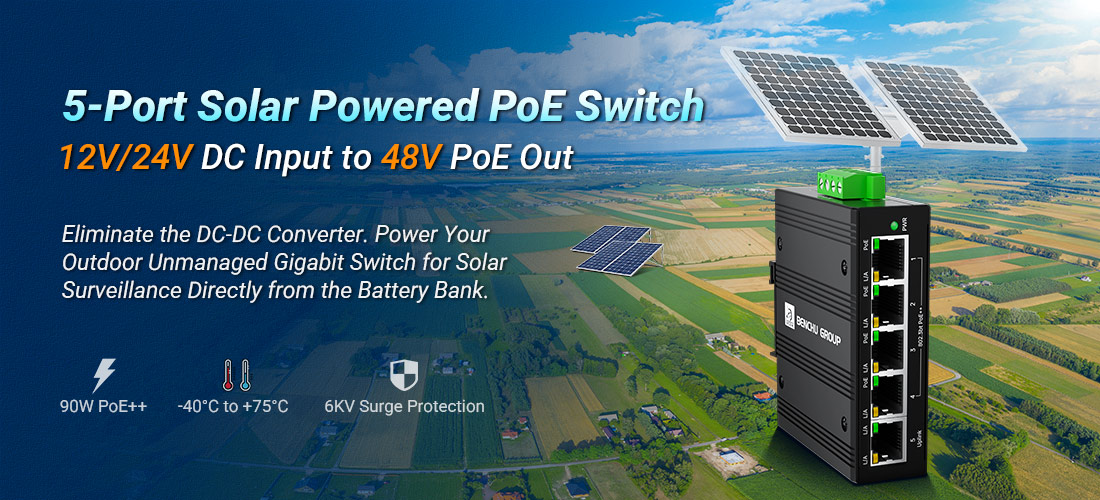
Remote surveillance and IoT connectivity in off-grid environments face a fundamental power mismatch: solar battery banks typically provide 12V or 24V DC, yet modern high-performance cameras and access points demand 48V to 57V Power over Ethernet. The Benchu IES7211-5PGE1GE-SOL—a dedicated 5-Port Solar Powered PoE Switch—addresses this gap through integrated voltage boosting technology. From a research and field-deployment perspective, this unmanaged gigabit switch eliminates the need for external DC-DC converters or inverters, significantly reducing points of failure while maintaining industrial-grade resilience in temperatures ranging from -40°C to +75°C. Below, we analyze the engineering principles behind its operation and compare its performance against traditional deployment methods to guide infrastructure decision-making.
The Engineering Challenge: Bridging Low-Voltage Storage and High-Voltage PoE
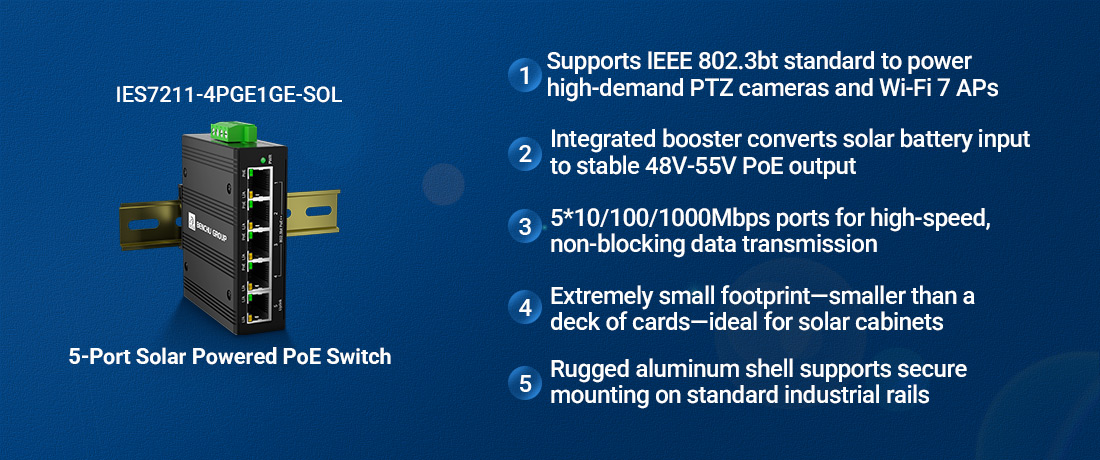
In typical solar-powered surveillance architectures, the system relies on a deep-cycle battery bank operating at a nominal 12V or 24V. Standard network switches, however, require either a stable 48V–54V input for PoE output or separate midspan injectors. The IES7211-5PGE1GE-SOL overcomes this limitation through an integrated wide-input DC-DC boost converter. The unit accepts a raw DC input range of 9V to 54V and intelligently steps up the voltage to a regulated 48V–55V rail specifically for the 4 Gigabit PoE++ ports. This design is particularly efficient for 12V/24V DC input to 48V PoE out scenarios, as it bypasses the double conversion losses associated with DC-AC-DC inverters. For researchers managing remote meteorological stations or wildlife camera traps, this native compatibility ensures that the power budget allocated from the solar array is utilized with maximum efficiency, preserving battery amp-hours during periods of low irradiance.
Hardware Resilience and Environmental Suitability
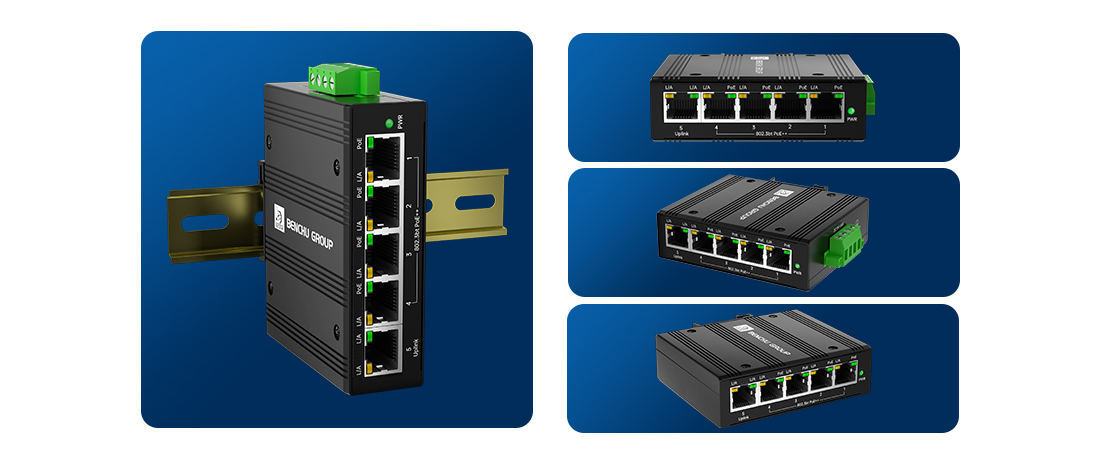
Field deployments subject networking hardware to extremes rarely seen in climate-controlled server rooms. This Outdoor Unmanaged Gigabit Switch for Solar Surveillance is built with a fanless, sealed aluminum chassis rated IP40, which relies on passive thermal dissipation to survive ambient temperatures from -40°C to +75°C. Beyond thermal tolerance, the unit integrates 6KV surge protection on all ports—a critical specification for pole-mounted solar panels and long outdoor cable runs that act as antennas for induced lightning transients. The inclusion of a dedicated Gigabit RJ45 uplink ensures that local NVRs or point-to-point wireless backhauls maintain non-blocking throughput. The switch’s compact DIN-rail form factor further simplifies cabinet integration, allowing it to reside alongside charge controllers and battery breakers without occupying excessive space.
Comparative Analysis: Integrated Boost vs. External Converter Topology
To appreciate the value proposition of this solar-optimized switch, it is useful to contrast it with a conventional industrial PoE switch deployed in the same environment. The table below outlines the operational differences when powering a 48V PoE PTZ camera from a 24V solar battery.
| Feature / Metric | Traditional Setup (24V Battery + 48V Step-Up Converter + Standard PoE Switch) | Benchu IES7211-5PGE1GE-SOL (Integrated Solution) |
| Voltage Conversion | External 24V-48V DC-DC converter required; introduces additional wiring and a single point of failure. | Internal Intelligent Booster; accepts 9-54V DC directly to PoE engine. |
| Efficiency Losses | Cascade losses (Converter ~90-95% + Switch ~85-90%). Typical total path efficiency < 85%. | Single-stage conversion optimized for 48V PoE Out; improves overall solar battery utilization. |
| Enclosure Footprint | Requires space for two distinct devices plus terminal blocks for 12V/24V tie-in. | Single compact unit; DIN-rail mountable. |
| Power Flexibility | Limited to converter's fixed output capacity. | Max PoE Budget (60W-240W) dynamically scales with available solar input power. |
| Deployment Complexity | Moderate; requires separate grounding and fusing for the step-up converter. | Low; Plug & Play integration with existing solar combiner boxes. |
Addressing High-Power Edge Devices with 802.3bt (90W)
The proliferation of Wi-Fi 6/7 access points and high-zoom PTZ cameras with heaters and wipers demands more than the legacy 30W of 802.3at. The IES7211-5PGE1GE-SOL is compliant with the IEEE 802.3bt standard (Type 4), enabling up to 90 Watts of power delivery per port. This capability ensures that even the most demanding edge devices can be deployed at remote solar sites without throttling performance or disabling onboard heating elements—a common compromise in cold-weather monitoring. It is important for system designers to note the relationship between input voltage and total PoE budget: while the switch is capable of handling up to 240W of PoE load, the actual deliverable power is a function of the connected battery and solar array capacity. This creates a responsive power management environment rather than a rigid, fixed-budget scenario.
Conclusion: Guiding the Decision for Autonomous Network Infrastructure
For system integrators and researchers designing the next generation of off-grid environmental monitoring or perimeter security, the choice of power delivery architecture is paramount. The Benchu IES7211-5PGE1GE-SOL demonstrates that an Outdoor Unmanaged Gigabit Switch for Solar Surveillance should not be a repurposed indoor device but a purpose-built industrial component. By merging 12V/24V DC Input to 48V PoE Out conversion, 90W PoE++ support, and ruggedized thermal protection into a single 5-Port Solar Powered PoE Switch, the solution reduces capital expenditure on ancillary converters and minimizes long-term maintenance visits to remote locations. For applications where uptime is critical and grid power is absent, this integrated approach provides a demonstrably more reliable and electrically efficient pathway for delivering data and power across the network edge.
 E-Mail Us
 Call Us
 Address
5F, Block5, GuangmingGu Industrial Park, Matian Villiage, Guangming Disitrict, Shenzhen, China



 IPv6 network supported
 English