IEEE 802.3bt standard

Home

IEEE 802.3bt standard

  • What is the maximum power output for POE++ per port?
    Apr 22, 2022
      The maximum power output per port for PoE++ (also known as IEEE 802.3bt standard) depends on the type of PoE++ used: --- Type 3 (60W): Delivers up to 60 watts per port. --- Type 4 (100W): Delivers up to 100 watts per port.     How PoE++ Achieves High Power Levels PoE++ (IEEE 802.3bt) uses four-pair power transmission to achieve these higher power levels. This differs from earlier PoE standards (PoE and PoE+), which use only two pairs of wires within the Ethernet cable. Here’s how the different types of PoE compare in terms of power output: PoE Standard IEEE Standard Max Power at Switch Port Power Available at Device PoE 802.3af 15.4W 12.95W PoE+ 802.3at 30W 25.5W PoE++ Type 3 802.3bt 60W 51W PoE++ Type 4 802.3bt 100W 71-90W     Detailed Breakdown of PoE++ Power Output 1. Type 3 PoE++ (60W): --- Switch Output: Supplies up to 60 watts per port. --- Power at Device: Provides up to 51 watts at the device, factoring in cable loss (which can vary based on the length and quality of the Ethernet cable). --- Applications: Type 3 PoE++ is suitable for moderately high-power devices like Wi-Fi 6 access points, PTZ IP cameras with advanced sensors, and multi-sensor devices. 2. Type 4 PoE++ (100W): --- Switch Output: Delivers a maximum of 100 watts per port. --- Power at Device: Depending on cable length, 71 to 90 watts are available at the device. --- Applications: Type 4 is designed for very high-power devices, such as digital signage, LED lighting systems, and industrial IoT equipment that require robust power.     Cable Quality and Length Considerations The power available at the device end (Powered Device, or PD) is always slightly less than what is supplied at the switch port (Power Sourcing Equipment, or PSE) due to power loss in the Ethernet cable. Factors that impact power loss include: --- Cable Type: Higher-quality cables like Cat6 or Cat6a experience less power loss compared to Cat5e cables. --- Cable Length: Longer cables experience more power loss, which can reduce the wattage available at the device end. Using Cat6 or Cat6a cables helps minimize this loss and enables efficient delivery of power, especially for high-power PoE++ applications.     Safety and Power Management in PoE++ PoE++ incorporates several safety and power management features to ensure safe and efficient delivery of high power: --- Device Detection and Classification: PoE++ switches use advanced classification to detect a connected device's power requirements and supply only the necessary power. Devices are classified into classes 5 to 8, with higher classes receiving more power. --- Overload Protection: If a device tries to draw more power than the switch can provide, the port will shut down to prevent overheating or damage. --- Temperature Control: High power output generates more heat, so PoE++ switches often include temperature sensors to monitor and manage heat levels.     Summary of PoE++ Power Output Benefits The high power levels offered by PoE++ (up to 100 watts per port) enable it to support advanced devices without the need for additional power infrastructure, making it ideal for applications in smart buildings, industrial automation, IoT, and high-power network devices. The IEEE 802.3bt standard's intelligent power management and safety features further ensure that devices receive the right amount of power safely and efficiently.    
    Read More
  • Can POE++ power PTZ cameras?
    Jul 27, 2022
      Yes, PoE++ is well-suited for powering PTZ (Pan-Tilt-Zoom) cameras, which often require more power than standard IP cameras due to their motorized mechanisms, advanced features, and enhanced night vision capabilities. PoE++ switches, which follow the IEEE 802.3bt standard, provide up to 60 watts per port for Type 3 and up to 100 watts per port for Type 4. This power capacity is generally sufficient to meet the demands of high-end PTZ cameras used in professional security and surveillance systems. Here’s a detailed breakdown of how PoE++ enables effective powering of PTZ cameras and why it is particularly advantageous for these types of devices:   1. Power Requirements of PTZ Cameras PTZ cameras require additional power compared to fixed IP cameras because of: --- Motorized Pan, Tilt, and Zoom Functions: PTZ cameras can change their orientation and zoom in/out on specific areas, which requires motors for movement, increasing the power demand. --- Advanced Night Vision: High-end PTZ cameras often include infrared (IR) illuminators, which allow them to capture clear images in low-light conditions but draw additional power. --- Additional Features: PTZ cameras often support high-resolution video (e.g., 4K), audio recording, and sometimes advanced AI-driven analytics (e.g., object tracking, facial recognition). These features require both processing power and sufficient power delivery, often necessitating higher power than standard PoE (15.4W) or PoE+ (30W) can provide.     2. How PoE++ Meets PTZ Camera Power Demands With the ability to deliver 60W or 100W per port, PoE++ is designed for applications where higher power delivery is essential, such as PTZ cameras. This higher power capability means: --- Reliability: PoE++ delivers consistent and sufficient power, reducing the risk of camera reboots or function loss during high-demand scenarios, such as simultaneous motor movement and IR illumination. --- Extended Range: PoE++ can support up to 100 meters of cable distance, sufficient for most surveillance installations. With signal extenders, the range can be increased even further, making it practical for large sites or complex outdoor installations.     3. Benefits of PoE++ for PTZ Camera Deployments Single Cable Solution: PoE++ provides both power and data over a single Ethernet cable, simplifying installation and reducing the need for separate power outlets near each camera location. This is particularly advantageous for PTZ cameras, which are often mounted in high or hard-to-reach locations. Reduced Infrastructure Costs: By eliminating the need for additional power wiring or nearby power sources, PoE++ simplifies deployment and reduces installation costs, particularly for large-scale security installations. Enhanced Security and Monitoring Capabilities: Since PoE++ allows cameras to operate at full capacity without power limitations, PTZ cameras can utilize all their features simultaneously, improving surveillance effectiveness. This is crucial in applications requiring 24/7 security, such as airports, stadiums, and critical infrastructure.     4. PoE++ and PTZ Camera Applications PoE++ is commonly used to power PTZ cameras in applications requiring high power, such as: City-Wide Surveillance: PTZ cameras with PoE++ can monitor large public spaces, adjust views, and zoom in on suspicious activities, all while maintaining high power to IR illuminators for nighttime visibility. Commercial and Industrial Security: In warehouses, manufacturing plants, and commercial buildings, PoE++ allows PTZ cameras to track movements across vast areas, adjust views based on activity, and maintain visibility in low-light conditions. Critical Infrastructure Monitoring: PTZ cameras in energy plants, transportation hubs, or water treatment facilities can run continuously and remain functional in demanding conditions with PoE++.     5. Considerations for Using PoE++ with PTZ Cameras Switch Power Budget: When connecting multiple high-powered PTZ cameras to a PoE++ switch, it’s essential to ensure that the switch’s total power budget can support all cameras. For example, a 24-port PoE++ switch with a 1,200W budget could theoretically power up to 20 PTZ cameras at 60W each but might need a higher budget for installations requiring 100W per port. High-Quality Cabling: Using high-quality Ethernet cables, such as Cat6 or Cat6a, is recommended to reduce power loss over longer distances and to ensure that PoE++ delivers stable power to each PTZ camera. Network Management Capabilities: A managed PoE++ switch can be useful in large-scale deployments where power distribution needs to be monitored and controlled across multiple PTZ cameras. Managed switches allow network administrators to prioritize power delivery, monitor power usage per port, and even schedule power cycling for remote maintenance.     6. Long-Term Benefits of PoE++ for PTZ Cameras Using PoE++ to power PTZ cameras enhances the longevity and functionality of security systems: --- Centralized Control: PoE++ switches make it easy to manage multiple PTZ cameras from a central location. Administrators can monitor power levels, troubleshoot remotely, and adjust settings without the need for physical access to each camera. --- Energy Efficiency: Many PoE++ switches have energy-saving features that allow unused ports to go into a low-power mode, minimizing energy waste in setups where some PTZ cameras may not operate continuously. --- Scalability: PoE++ provides flexibility for adding more PTZ cameras or upgrading existing ones, as the higher power capacity can accommodate newer models with advanced capabilities.     Summary PoE++ is an ideal power solution for PTZ cameras, as it meets the high power requirements of these advanced devices. By delivering up to 100 watts per port, PoE++ can support all of the operational features of PTZ cameras, including motorized movement, night vision, and high-resolution video capture. The single-cable design simplifies installation, reduces costs, and ensures reliable operation in critical security applications. For settings like large-scale surveillance, urban monitoring, and infrastructure security, PoE++ switches provide the robust power and efficiency necessary to maximize PTZ camera performance.    
    Read More
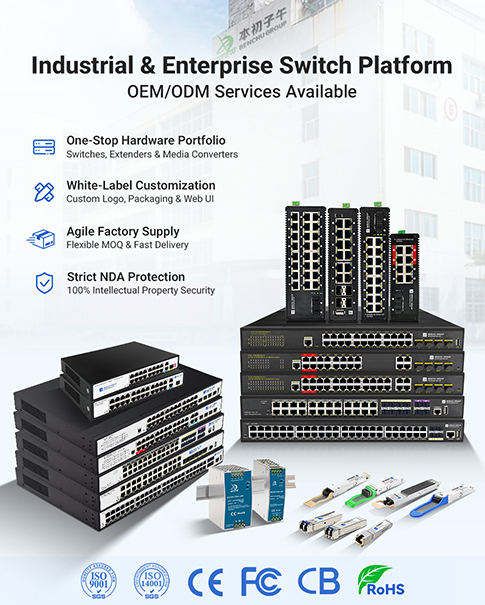
  • Industrial PoE++ Switch Audit: Validating True 802.3bt Hardware vs. Commercial Clones
    Jul 09, 2026
    Procurement & Engineering Audit by: Benchu Group Infrastructure Labs Standard Verification: IEEE 802.3bt Type 4 Compliance As heavy-duty edge applications—such as multi-sensor PTZ tracking cameras, outdoor Wi-Fi 7 base stations, and localized AI computing nodes—proliferate across municipal and industrial grids, the demand for high-capacity PoE++ Switch hardware has skyrocketed. However, this surge has triggered a dangerous influx of budget-engineered "commercial clones" into the B2B market. While these look-alike systems boast impressive 90W specifications on their marketing brochures, a rigorous technical audit frequently reveals severe structural shortcuts that compromise operational continuity in mission-critical field deployments. 📷 [IMAGE PLACEHOLDER: PRODUCT COMPARISON HORIZONTAL POSTER] (Upload horizontal infographic showing hardware teardown comparison here: True industrial DIN-rail components vs. cheap commercial clone internal layout) The "Paper Spec" Trap: Understanding Commercial Clone Architecture Commercial clones are essentially consumer-grade or light-enterprise desktop switches repackaged inside ruggedized sheet-metal enclosures. They utilize cheap, unisolated PSE (Power Sourcing Equipment) controllers and low-tier, commercial-grade electrolytic capacitors that degrade rapidly when subjected to real-world operational stress. ⚠️ Hidden Engineering Bottleneck: Shared Power Topologies The most prevalent vulnerability lies in their shared power distribution topologies. A clone may claim compliance with the **IEEE 802.3bt standard**, but it lacks the dynamic power negotiation microcode and robust thermal pathways required to sustain a continuous 90W load across multiple ports simultaneously. When multi-channel high-power devices activate at the same moment, the total power pool undergoes critical instability. Under full operational load, the voltage sags sharply below the 50V required for stable Type 4 PoE delivery. This causes the internal power rail to fluctuate violently, inducing high jitter in data packages and triggering uncommanded, cyclical device reboots that paralyze your remote edge networks precisely when stability is needed most. 📋 Technical Audit Matrix: True Industrial vs. Commercial Clones Hardware Subsystem Commercial Clone Vulnerabilities Benchu True 802.3bt Engineering PSE Controller Silicon Unisolated consumer chipsets; prone to cross-port thermal cascading. Isolated, enterprise-grade PSE processors with independent port protections. Power Handshake Protocols Forced static voltage output; lacks hardware-level Layer 1 LLDP handshaking. Dynamic 4-pair hardware classification with adaptive power negotiation. Surge & Isolation Barrier Minimal 1kV protection; shared grounding that risks multi-port destruction. 6kV surge protection per port with 2.25kV DC electrical isolation. Core Circuit Topology: Dynamic 802.3bt Power Isolation vs. Standard Unisolated Clones 📷 [IMAGE PLACEHOLDER: TECHNICAL COMPARISON HORIZONTAL INFOGRAPHIC POSTER] (Upload horizontal schematics/topology map contrasting Benchu's multi-stage optocoupler isolation circuits against the direct-injection unisolated backplane layout found in generic clones) How to Validate True 802.3bt Hardware: The 3-Step Engineering Audit To protect your field infrastructure from premature failure and unexpected network downs, procurement teams and network engineers must look past superficial datasheet marketing. It is vital to execute an empirical, hardware-level verification audit focusing on three core industrial design pillars: 01 Layer 1 and Layer 2 Dynamic Handshaking Verification True IEEE 802.3bt hardware utilizes a precise, multi-stage hardware handshake before releasing Type 4 power up to 90W. It safely checks the signature resistance and capacitance of the Powered Device (PD) across four pairs of twisted copper wires. This intelligent classification protocol dynamically reads whether the device requires Class 5 through Class 8 power limits, continuously negotiating via LLDP (Link Layer Discovery Protocol) data blocks under active conditions. Commercial clones frequently bypass this complex silicon negotiation. To save manufacturing costs, they rely on basic hardware injectors that force a static high voltage straight down the copper lines. This improper, unnegotiated power delivery creates massive risks: it can instantly fry legacy non-PoE hardware accidentally patched into the network, or overheat mid-power endpoints that are not engineered to withstand raw, unmanaged Type 4 energy feeds. 02 Per-Port Electrical and Optical Isolation Auditing Industrial environments are heavily plagued by severe electromagnetic interference (EMI), variable ground loops, and high-voltage lightning transients. A genuine industrial-grade switch features heavy-duty electrical isolation barriers—often using high-grade optocouplers and dedicated transformers—that isolate the delicate core switching logic from the raw power delivery circuits. When a cheap commercial clone suffers an outdoor lightning surge on an external PTZ camera copper line, it lacks the necessary per-port barriers to dump that excess energy safely to ground. Because the internal grounding plane is shared across all channels without true physical isolation, the transient pulse routinely cascades straight through the data backplane. The resulting chain-reaction short circuit instantly destroys the entire switch assembly, taking every other connected device down with it. 03 Real-World Optical Backhaul Stability Under Full PoE Load A high-power edge switch is only as reliable as its backhaul interface. When multiple high-draw devices pull heavy Type 4 wattage simultaneously, a massive amount of localized thermal dissipation is generated inside the switch housing. Genuine industrial architectures isolate these high-heat components from the sensitive data ports using advanced localized thermal barriers and distinct physical PCB separation. Commercial clones, by contrast, squeeze all components together onto a single unshielded board. As full-load power operations bake the enclosure from the inside out, this uncontrolled heat conducts directly into the adjacent SFP optical transceiver slots. The excessive thermal stress shifts the operating laser wavelength of the SFP modules, leading to sudden, hard-to-diagnose fiber packet drops, high signal jitter, or absolute backhaul link disconnection that blinds the central control center completely. The Strategic Value of Audit-Certified Infrastructure Investing in a rigorously audited, true industrial platform ensures critical operational advantages and long-term lifecycle cost savings for network operators, municipal engineers, and systems integrators alike: ✓ Drastic Reduction in Operational Truck Rolls: Eliminates mysterious field system drops, random freezing, and uncommanded camera power cycles caused by unstable, unisolated clone power rails. ✓ Future-Proof Topology Deployment: Provides complete, hardware-level backwards compatibility across IEEE 802.3af/at legacy devices while remaining fully prepared for next-generation, high-capacity Type 4 PoE++ hardware. ✓ Uncompromising Perimeter Security: Guarantees smooth, continuous optical data backhaul and high-definition video transmission streams even when outdoor field temperatures hit extreme seasonal peaks. Deploy True, Audit-Verified PoE++ Infrastructure Protect your network edge from the hidden vulnerabilities of consumer-grade clones. Contact Benchu Group’s engineering team today for independent laboratory testing data, complete structural compliance records, and direct project-level pricing. Request Technical Auditing Kit & RFQ
    Read More

QUOTE IN 24H

Get Custom Quote
Send requirements below. Our technical sales team will reply with tailored pricing within 24 hours.
submit

home

products

WhatsApp

Contact Us