How 90W Gigabit PoE Extenders Work?
Jul 27, 2026
802.3bt 90W PoE++ Extender: Delivering Guaranteed 72W Power Over 200m Beyond the 100m Ethernet Limit
An engineering analysis of high-wattage IEEE 802.3bt line transmission, insertion loss minimization, and extended-distance edge node power budgeting.
Executive Summary: Extended-Range High-Power Ethernet Delivery
An industrial PoE extender, also commonly referred to as a PoE repeater or PoE Ethernet repeater, is an active inline networking device designed to regenerate Gigabit Ethernet signals while maintaining high-power DC delivery over copper twisted pairs. By utilizing efficient power management and signal regeneration technology, it overcomes the traditional 100-meter (328 ft) IEEE 802.3 Ethernet distance limitation to deliver guaranteed 72W load power at 200 meters (656 ft) from an IEEE 802.3bt Type 4 PSE source supplying up to 90W PoE input.
Core Technical Highlights:
High-Efficiency Power Delivery: Delivers up to 72W guaranteed load power over 200m of 23AWG Cat6 copper cabling, enabling high-power endpoints without local AC wiring.
Gigabit Signal Integrity: Active Ethernet signal regeneration maintains reliable full-duplex Gigabit transmission over extended cable distances.
Industrial Environmental Protection: Hardened IP40 metal chassis with wide temperature support from -40°C to +75°C, designed for demanding outdoor and industrial deployments.
90W Gigabit PoE Extender Deployment Topology Delivering 72W Power Over a 200m Extended Ethernet Link
1. The Physics of PoE Cable Transmission: Why Standard PoE Reaches Its 100-Meter Limit
The fundamental limitation of copper-based Ethernet transmission is determined by two physical factors: high-frequency signal attenuation and DC power loss caused by cable resistance. Standard twisted-pair Ethernet cables, including Cat5e and Cat6, have a measurable DC loop resistance of approximately 14–20 ohms per 100 meters, depending on conductor size (24AWG vs. 23AWG).
Conductor Loss (I²R Heat Dissipation)
When an IEEE 802.3bt Type 4 Power Sourcing Equipment (PSE) delivers up to 90W PoE power at approximately 50V–57V DC, current flowing through long copper conductors creates voltage drop and heat loss. As cable distance increases, the available voltage at the Powered Device (PD) side decreases, potentially causing insufficient power delivery, cable heating, and unexpected device resets for high-power endpoints.
Signal Attenuation and Inter-Symbol Interference (ISI)
At the same time, Gigabit Ethernet (1000BASE-T) signals experience high-frequency attenuation, insertion loss, and phase distortion across copper pairs. As transmission distance increases beyond the standard 100-meter channel limit, signal margins decrease and the risk of packet errors and unstable links increases.
2. Engineering Mechanism: How a 90W Gigabit PoE Extender Extends Ethernet Data and High-Power PoE Delivery
To overcome Ethernet distance limitations without installing additional AC power infrastructure, an inline Gigabit PoE extender operates as an active mid-span signal regeneration and power management device. Installed near the end of the first 100-meter Ethernet segment, the extender performs three coordinated operations:
1
Physical Layer (PHY) Data Regeneration
Unlike passive cable extensions that suffer from signal attenuation, the internal Ethernet PHY receives and regenerates incoming data signals, restores signal integrity, and retransmits Gigabit Ethernet traffic across the extended cable segment. This active regeneration maintains reliable full-duplex communication beyond the standard 100-meter Ethernet limitation.
2
Efficient DC-DC Power Conditioning
The integrated power management circuit regulates incoming IEEE 802.3bt PoE power, compensates for cable-related voltage loss, and efficiently delivers power to downstream Powered Devices (PDs). Optimized conversion efficiency minimizes internal power consumption while maximizing available output power for remote high-power endpoints.
3
IEEE 802.3bt Detection & Power Negotiation
The integrated PoE controller performs automatic detection, classification, and power negotiation between the upstream PSE and downstream PD. By managing four-pair PoE operation and monitoring electrical conditions, the extender ensures stable power delivery while protecting connected equipment from abnormal operating conditions.
3. Real-World Power Performance: Delivering Guaranteed 72W Over 200 Meters
A key concern among system integrators is determining the actual available power at the remote endpoint of an extended copper Ethernet link. The following comparison illustrates power delivery performance using 23AWG solid copper Cat6 cabling:
Link Configuration
Distance
PSE Input Power
Guaranteed Available PD Power
Standard Direct PoE Link
100 Meters
90W IEEE 802.3bt Type 4
~71W
Single 90W PoE Extender Link
200 Meters
90W IEEE 802.3bt Type 4
72W Guaranteed Load Power
Dual Extender Cascaded Link
300 Meters
90W IEEE 802.3bt Type 4
~52W–55W
Note: Power calculations are based on 23AWG solid copper Cat6 cabling. Actual delivered power may vary depending on cable quality, connector resistance, ambient temperature, and installation conditions.
Featured Hardware: Industrial 90W Gigabit PoE Extender & Repeater
HARDWARE SPECIFICATION
POE-IEX01G-BT90
Industrial 90W Gigabit PoE Extender & Repeater | OEM / ODM
• High-Efficiency 90W Passthrough: Accepts up to 90W IEEE 802.3bt input, supplying a maximum local output of 85W and maintaining 65W guaranteed load power at 200 meters (656 ft).
• Single-Port Longspan PoE Extension: Heavy-duty inline repeater extending Gigabit data and high-wattage power beyond the standard 100m Ethernet limit without local AC wiring.
• Industrial Hardening: IP40 aluminum alloy enclosure, fanless passive cooling, wide operating temperature (-40°C to +75°C), 6kV surge protection, and ESD protection (±8kV Contact, ±15kV Air).
• Plug-and-Play Auto-Sensing: Inline PoE extender with auto-sensing IEEE 802.3af/at/bt protocol matching to prevent power-overload damage to legacy network gear.
📁 Deployment: Perimeter PTZ & Thermal Cameras, Next-Gen Outdoor Wi-Fi 7 / 6E APs, & Remote 5G Industrial IoT Edge Gateways.
GET DATASHEET & PROJECT QUOTE →
4. Industrial Applications and Reliability Features of 90W PoE Extenders
A high-wattage industrial PoE extender, also known as a PoE repeater, is primarily deployed in outdoor and remote environments where installing local AC power infrastructure is costly or impractical. Typical application scenarios include:
Outdoor PTZ Cameras with Thermal Heaters
High-power pan-tilt-zoom cameras equipped with IR illuminators and built-in heaters may require 50W–60W startup or peak heating power. Delivering 72W guaranteed load power over 200m ensures stable operation for remote surveillance systems in cold-weather environments.
Remote 5G Cellular CPEs & Wi-Fi 6/6E/7 Access Points
Outdoor wireless devices installed on agricultural smart poles, highway structures, or industrial sites require stable, regulated high-wattage power while maintaining reliable Gigabit Ethernet connectivity over extended cable distances.
Harsh Environment Reliability
For roadside cabinets and industrial enclosures, a rugged industrial PoE extender combines a fanless IP40 aluminum chassis, wide temperature operation from -40°C to +75°C, 6kV surge protection, and ESD protection to ensure reliable long-term operation in demanding field deployments.
Conclusion & OEM/ODM White-Label Availability
Deploying a 90W IEEE 802.3bt-compliant PoE extender solution enables network architects to overcome traditional copper distance limitations while maintaining reliable high-power delivery for next-generation edge devices. By extending Gigabit Ethernet and PoE power beyond the standard 100-meter boundary without requiring additional AC wiring, industrial PoE extenders provide a cost-effective and low-maintenance solution for remote deployments.
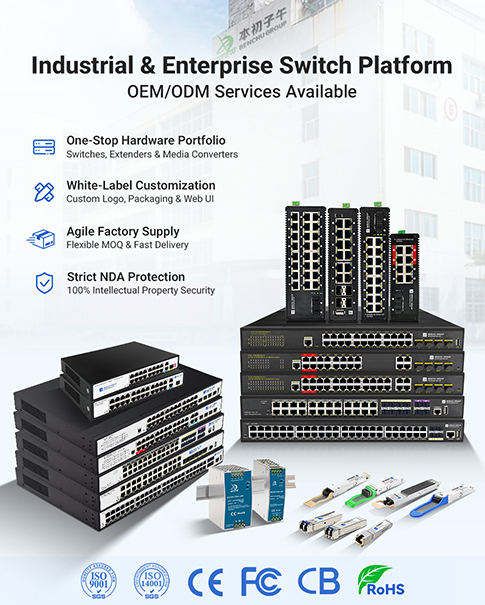
For System Integrators & Global Brand Owners: BENCHU provides ODM and white-label manufacturing services, including custom enclosure branding, logo printing, product labeling, and customized firmware options for industrial networking applications.
Need Technical Datasheets or Custom ODM Pricing?
Contact our engineering team to access detailed test reports, request evaluation samples, or discuss customized OEM/ODM supply solutions for your industrial networking projects.
REQUEST DATASHEET & ODM QUOTATION →
Read More

 E-Mail Us
 Call Us
 Address


 IPv6 network supported
 English