What are the Differences Between Managed and Unmanaged Switches?
Jul 19, 2024
What are the Differences Between Managed and Unmanaged Switches?
When setting up a network, selecting the right switch is crucial for ensuring performance, scalability, and reliability. Two main types of switches you'll encounter are managed and unmanaged switches. Understanding their differences can help you make an informed decision tailored to your specific networking needs. This post will explore the key distinctions between managed and unmanaged switches, with a particular focus on Managed PoE Switches, Unmanaged PoE Switches, and Network PoE Switches.
What is a Managed Switch?
A Managed PoE Network Switch offers advanced features for controlling and managing your network. It allows network administrators to configure, manage, and monitor the network in various ways to improve efficiency and security.
Key Features of Managed Switches:
VLANs (Virtual LANs): Segment the network into different broadcast domains to improve security and performance.
Quality of Service (QoS): Prioritize certain types of traffic, ensuring critical data gets the bandwidth it needs.
Network Monitoring: Tools such as SNMP (Simple Network Management Protocol) to monitor network performance and detect issues.
Redundancy Features: Support for protocols like STP (Spanning Tree Protocol) to prevent network loops.
Advanced Security: Enhanced security features to control access and protect the network from unauthorized users.
A Managed PoE Switch not only offers these advanced management features but also provides Power over Ethernet (PoE), allowing you to power devices such as IP cameras, wireless access points, and VoIP phones directly through the Ethernet cable.
What is an Unmanaged Switch?
An Unmanaged Switch is a plug-and-play device that requires no configuration. It works out of the box and allows devices to communicate with each other on the network without any manual setup.
Key Features of Unmanaged Switches:
Ease of Use: Simple to set up and use, requiring no technical expertise.
Cost-Effective: Typically less expensive than managed switches, making them ideal for small networks or home use.
Basic Connectivity: Provides basic network connectivity without any advanced features or customization.
An Unmanaged PoE Switch offers the same plug-and-play simplicity while providing PoE capabilities. This makes it suitable for small networks where simplicity and cost are more critical than advanced features.
Differences Between Managed and Unmanaged Switches
Control and Management:
Managed Switch: Offers comprehensive control over network settings, traffic prioritization, and monitoring.
Unmanaged Switch: Provides no management capabilities and works automatically without configuration.
Performance Optimization:
Managed Switch: Allows optimization of network performance through VLANs, QoS, and traffic management.
Unmanaged Switch: Limited to basic data forwarding with no performance optimization features.
Security:
Managed Switch: Enhanced security features like network access control, monitoring, and VLANs to segregate sensitive data.
Unmanaged Switch: Basic security, typically relying on physical network security rather than internal configurations.
Scalability:
Managed Switch: Scalable for growing networks, suitable for enterprise environments.
Unmanaged Switch: Best for small, static networks with no plans for expansion.
Cost:
Managed PoE Network Switch: Higher cost due to advanced features and management capabilities.
Unmanaged PoE Network Switch: Lower cost, making it budget-friendly for small or home networks.
Choosing the Right Switch for Your Needs
When deciding between a managed and unmanaged switch, consider your network's size, complexity, and future growth. For small networks that require minimal configuration and management, an gigabit ethernet unmanaged poe switch may be sufficient. However, for larger, more complex networks that require advanced features and greater control, a Managed PoE Switch would be a better fit.
A Network PoE Switch, whether managed or unmanaged, adds the benefit of powering devices over the same cable used for data transmission. This simplifies installation and reduces the need for additional power supplies, making it an excellent choice for powering network devices efficiently.
Understanding the differences between managed and unmanaged switches is essential for selecting the right equipment for your network. Managed switches offer advanced features and control, making them suitable for larger, more complex networks, while unmanaged switches provide simplicity and cost-effectiveness for smaller, less demanding environments. By considering your specific needs and future growth plans, you can choose the appropriate switch to ensure your network operates smoothly and efficiently. Whether you opt for a Managed PoE Switch or an Unmanaged PoE Switch, leveraging the power and data capabilities of a Network PoE Switch can significantly enhance your network's flexibility and performance.
Related Product Side-by-Side Comparison
Models
SP5210-8PGE2GF8 Ports PoE Unmanaged Switch
SP5220-24PGE2GF24 Ports PoE Unmanaged Switch
SP7500-8PGE2GF8 Ports PoE Managed Switch
SP7500-24PGE4GC-L2M24 Ports PoE Managed Switch
IES7511-8PGE2GF-DC8 Ports PoE Industrial Managed Switch
Switching Capacity
24Gbps
52Gbps
32Gbps
128Gbps
24Gbps
Physical Port
8-1G PoE + 2-1G SFP
24-1G PoE + 2-1G SFP
8-1G PoE + 2-1G SFP
24-1G PoE + 4-1G RJ45 + 4-1G SFP
8-1G PoE + 2-1G SFP
POE Standard
IEEE 802.3at / 30W
IEEE 802.3at / 30W
IEEE 802.3at / 30W
IEEE 802.3at / 30W
IEEE 802.3at / 30W
POE Budget
120W (Internal Power Supply)
300W (Internal Power Supply)
120W (Internal Power Supply)
400W (Internal Power Supply)
120W
Power Input
AC 100V-240V, 50/60Hz
AC 100V-240V, 50/60Hz
AC 100V-240V, 50/60Hz
AC 100V-240V, 50/60Hz
DC 48~56V (Dual redundant inputs)
Housing / Mount
Metal / Rack-mout
Metal / Rack-mout
Metal / Rack-mout
Metal / Rack-mout
Aluminum / DIN-Rail
Operating Temp
-20°C to +55°C
-20°C to +55°C
-20°C to +55°C
-20°C to +55°C
-40°C to +85°C
Surge
ESD 4KV
ESD 6KV
ESD 4KV
ESD 6KV
ESD 6KV
Type
Unmanaged
Unmanaged
L2+ Managed
L2+ Managed
L2+ Managed
Action
View Detail
View Detail
View Detail
View Detail
View Detail
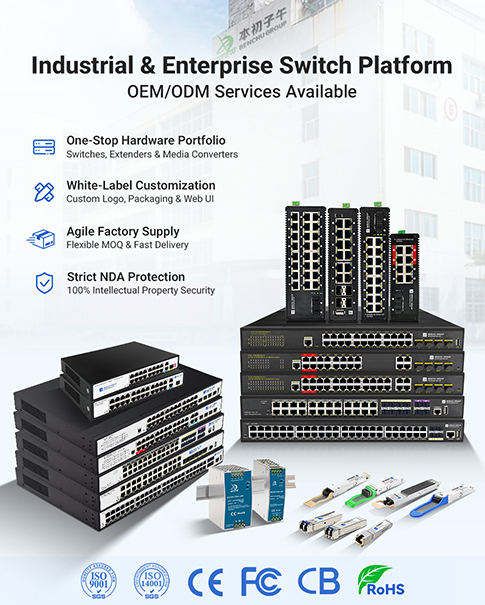
🚀 OEM/ODM & White Label Services Available
Empower your brand with Benchu's 10+ years of PoE & Industrial Switch manufacturing expertise. We provide more than just hardware; we provide your brand's competitive edge.
Branding & ID
Laser-etched Logo & Custom Labels
Brand-specific Packaging (Giftbox/Carton)
Unique Housing Colors (RAL/Pantone)
Software & Tech
Custom Default IP/Login Credentials
Private MIBs & Specialized Firmware
PCBA-only Options for System Integration
Ready to Build Your Own Brand?
Standard OEM Lead Time: 2-3 Weeks | Low MOQ Branding
+86 755 23246531 | sales@benchu-group.com | WhatsApp: +86-17322314741
Get a Tailored Quote Now
Read More

 E-Mail Us
 Call Us
 Address


 IPv6 network supported
 English