What is a Power over Fiber Switch (PoF Switch) and How Does It Work?
In the era of smart cities, gigabit connectivity, and next-generation all-optical campus infrastructure, network architects face a persistent, two-headed engineering dilemma at the network edge.
Traditional copper-based Power over Ethernet (PoE) wiring is fundamentally shackled by a strict 100-meter physical distance limit, rendering it useless for wide-area deployment. To bypass this, engineers often turn to standard passive optical networks (POL) or GPON frameworks. While fiber optics easily shatter distance barriers and deliver massive bandwidth, they possess a critical operational flaw: they transmit data, but zero electricity. As a result, deploying remote edge nodes—such as high-definition IP security cameras, outdoor wireless Access Points (APs), and industrial IoT gateways—still forces field technicians to source and install local AC 100-240V utility power boxes grid connections at every single field endpoint. This massive power layout dependency drastically inflates civil construction budgets, drags down deployment timelines, and multiples hardware failure vulnerabilities.
To break this structural bottleneck, progressive telecommunication deployment is pivoting toward a revolutionary infrastructure architecture: the Power over Fiber Switch (PoF Switch) system.
Defining the Power over Fiber (PoF) Core Architecture
A Power over Fiber Switch (PoF Switch) is a next-generation central office backbone hub engineered to deliver both high-bandwidth Gigabit data forwarding and dynamic electrical power injection simultaneously over non-metallic hybrid optical-electrical cables.
Unlike traditional networks that isolate power and signaling into completely different physical paths, this enterprise-grade all-optical central infrastructure centralizes all field power allocation into one secure, climate-controlled IT machine rack. By integrating heavy-duty, high-efficiency internal power supply modules, the core switch acts as a centralized remote optical powering transmitter. Instead of forcing technicians to pull fragile glass strands alongside separate thick electrical copper conduits across a campus or industrial floor, the network runs entirely on specialized, integrated hybrid powered fiber optic cables.
The Dual-Core Transmission Engine
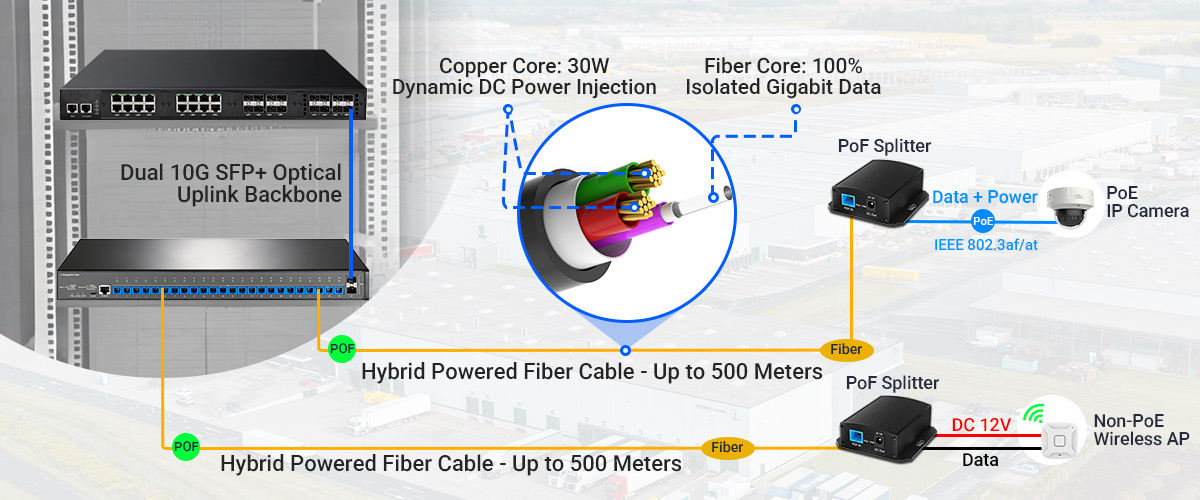
The core operational magic of the Power over Fiber switch system lies in how it segregates data and power distribution inside a unified, armored hybrid optical-electrical cable assembly:
- The Fiber Core (Data Pathway): All network communication signaling, spanning from hardware-based Layer 3 IPv4/IPv6 routing protocols down to VLAN tags, flows exclusively through the non-conductive glass optical fiber cores. Because network logic does not rely on a metallic bus for data backhaul, the pipeline achieves absolute wire-speed gigabit throughput with near-zero latency.
- The Copper Core (Power Pathway): Bundled parallel within the same non-metallic structural sheath, heavy-duty industrial copper conductors carry the centralized low-voltage DC power current injected directly by the PoF core switch. This allows up to 30W of dynamic power to be pushed per line away from the central machine room.
Delivering 100% Data Channel Galvanic Isolation
By forcing network signaling to travel strictly through pure non-conductive glass optics rather than copper wires, a Power over Fiber Switch (PoF Switch) delivers an unmatched industrial protection score: 100% data channel galvanic isolation.
In high-density industrial park CCTV grids, petrochemical plants, and electrical substations, ground loop faults frequently destroy sensitive IT core hardware. When outdoor field cameras are connected via traditional metallic networks, ground potential variances between the central machine room and a remote pole 500 meters away generate dangerous transient loop currents. Furthermore, outdoor remote network endpoints are highly vulnerable to catastrophic direct lightning strikes, which readily propagate along copper lines straight back into your data center.
By eliminating the copper connection for network data, the PoF system structurally breaks the physical pathway for ground loops and lightning surges. Transient high-voltage spikes hit a literal brick wall of glass fiber insulation, ensuring zero packet loss, jitter-free video streams, and total absolute hardware backbone protection, even under the harshest electromagnetic interference (EMI) noise spikes.
The All-Optical Network Ecosystem: Why the PoF Switch Demands a Dedicated PoF Splitter
Deploying a high-density, centralized optical powering network is not a single-device job. While the central office Layer 3 Managed Power over Fiber Switch acts as the uncompromised "heart" of the network—pumping data and raw DC electricity down the lanes—the remote endpoints require a specialized "receiver" to safely unpack and utilize these streams. This is where the Power over Fiber Splitter (PoF Splitter) comes into play as an indispensable ecosystem terminal.
Traditional powered fiber deployments often fall short during field installation because technicians are forced to handle complex, separate termination tasks at the edge. They have to splice fragile glass fibers using expensive fusion machinery while simultaneously screwing down heavy metallic electrical conductors into separate terminal blocks. This multi-step process introduces high margins for connection errors and severely drags down engineering timelines.
Our industrial-grade PoF Splitter completely shatters this field deployment barrier by integrating a patented SC Quick Hybrid Connector slot. With this design, field installers can secure both the gigabit optical link and the low-voltage DC power stream in a single, one-click snap motion, effectively slashing onsite deployment labor bills by up to 50%.
Engineering Realities: Line Loss and the Power of Dynamic Dual-Mode Output
When designing wide-area all-optical infrastructures, seasoned network engineers look for realistic, verified hardware performance rather than theoretical marketing claims. In any remote DC injection network, pulling power across long distances inevitably triggers the laws of physics. As electricity travels through 500 meters of copper wire core, it encounters natural resistance, resulting in unavoidable line loss and voltage drops. Furthermore, the splitter's internal photovoltaic conversion chips and PoE negotiated circuits consume operational power dissipation.
To establish absolute engineering transparency, our network architecture accounts for these variables directly. While the central transmitter switch injects up to 30W per line, the PoF Splitter delivers a rock-solid, continuous 15W net power budget at the 500-meter edge. This net energy is perfectly sufficient to drive universal modern end devices, adapted through a highly flexible dual-mode power delivery architecture:
- Mode A - Gigabit RJ45 PoE Output: The splitter decodes the incoming powered stream and converts it directly into standard IEEE 802.3af/at adaptive Power over Ethernet (PoE) via a standard RJ45 port. This allows instant, single-cable plug-and-play hookups for modern enterprise wireless APs and HD IP fixed or dome surveillance cameras.
- Mode B - Common Circular DC 12V Barrel Jack: For industrial telemetry sensors, older analog/IP bullet cameras, or edge network routing gateways that do not natively support PoE, the splitter channels steady electricity out through a dedicated, heavy-duty circular DC 12V barrel jack, ensuring total cross-generation hardware compatibility.
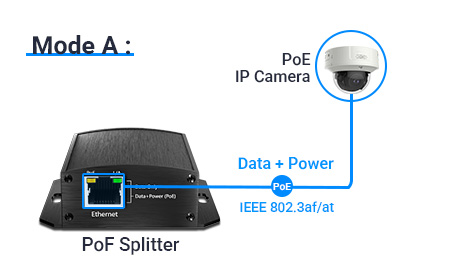
Mode A: One-Cable Standard PoE Output Connection
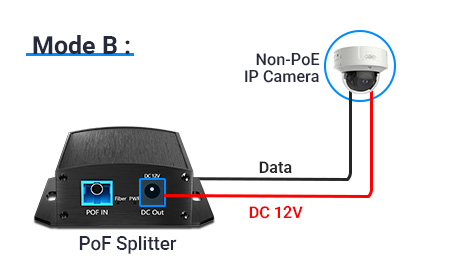
Mode B: Circular DC 12V Barrel Jack Legacy Connection
Unlocking Value: 3 Mission-Critical Application Scenarios for PoF Networks
The seamless combination of a Layer 3 managed core switch and a flexible dual-mode terminal splitter makes the Power over Fiber (PoF) network the absolute gold standard for several high-budget vertical markets:
1. Smart Campus FTTD All-Optical Infrastructures
Modern educational institutions demand wall-to-wall Wi-Fi coverage and high-speed data. However, running local AC power grid conduits through ancient school concrete structures, corridor ceilings, or wide outdoor stadiums is a budgeting nightmare. By placing the 24-port PoF switch in the central IT rack, campus networks can run 10G optical backbone trunks out to 500m endpoints, powering high-bandwidth wireless APs via the splitter's PoE port without ever tapping into the edge power grid.
2. High-Density Industrial Park & Lightning-Proof Remote CCTV
Perimeter security across expansive logistics centers, sea-crossing bridges, and remote highways is constantly threatened by severe outdoor lightning strikes. When cameras are linked via copper wiring, lightning surges readily travel straight back down the wire, instantly wiping out expensive central machine room servers. A PoF network isolates the data pathway completely inside pure glass fibers. Even if a lightning surge hits an outdoor traffic pole box case, the core server room remains entirely isolated, keeping mission-critical networks live with zero packet loss.
3. Smart Factory Automation & High-EMI Hazardous Zones
Heavy industrial manufacturing environments are plagued by heavy-machinery cross-EMI magnetic noise spikes that constantly distort traditional data signals. Furthermore, in hazardous sectors like petrochemical plants, oil refineries, and mine shafts, any electrical wire friction that generates a spark or electro-static discharge can cause catastrophic disasters. A PoF network delivers a completely intrinsically safe networking environment, routing clean, uncorrupted gigabit data through electromagnetic-immune glass paths while securely feeding field PLCs and sensors up to 500 meters away.
Core System Components: Building the End-to-End PoF Network
To successfully deploy an intrinsically safe, centralized optical powering infrastructure, the system utilizes two complementary hardware elements. Explore our perfectly matched transmitter and receiver nodes below:
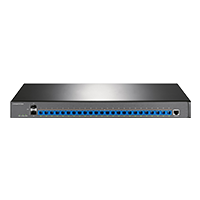
1. Central Transmitter
POF7500-24PGF2TF-L3M
24-Port Gigabit Layer 3 Managed PoF Switch
The server room hub. Manages hardware-level Layer 3 enterprise routing and injects a massive 500W aggregate low-voltage DC budget directly into long-distance hybrid powered fiber lines up to 500 meters away.
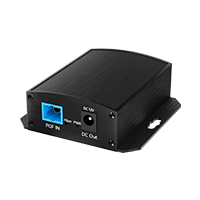
2. Edge Receiver Endpoint
PoF-SPL-1G12V
Remote Industrial Power over Fiber Splitter
The field-end terminal. Decouples the 500m SC hybrid composite cable line, adapting the net 15W continuous budget into flexible dual powering outputs: standard Gigabit RJ45 PoE and a circular DC 12V barrel jack.
Conclusion: Partner with a Leading Shenzhen Hardware Manufacturer
The Power over Fiber (PoF) centralized network architecture represents a massive paradigm shift in wide-area data forwarding and electrical engineering. By consolidating your power assets into one centralized server rack and breaking the traditional distance limits of copper cabling, your infrastructure projects can achieve unmatched lightning safety, total EMI immunity, and massive long-term material cost rollbacks.
As a verified, premium industrial network switch manufacturer based in Shenzhen, China, Benchu group are committed to providing more than just standard, off-the-shelf hardware. We offer robust B2B OEM/ODM customization services, allowing global system integrators and telecom distributors to request customized metal enclosure footprints, optimized port layouts, specialized Layer 3 protocol sets, and custom dynamic power budgets tailored precisely to international bidding (RFP/RFQ) specifications.
Take Your Infrastructure to the Next Level
Ready to eliminate edge wiring costs and build an immune network? Contact our Shenzhen factory technical sales team for free network topology blueprint evaluations and competitive factory-direct wholesale quotes.
📧 Email Us Directly:
sales@benchu-group.com👉 Or click the
"LEAVE A MESSAGE" tab on the right side of this screen!
 English



 E-Mail Us
 Call Us
 Address


 IPv6 network supported